
Skill evaluations
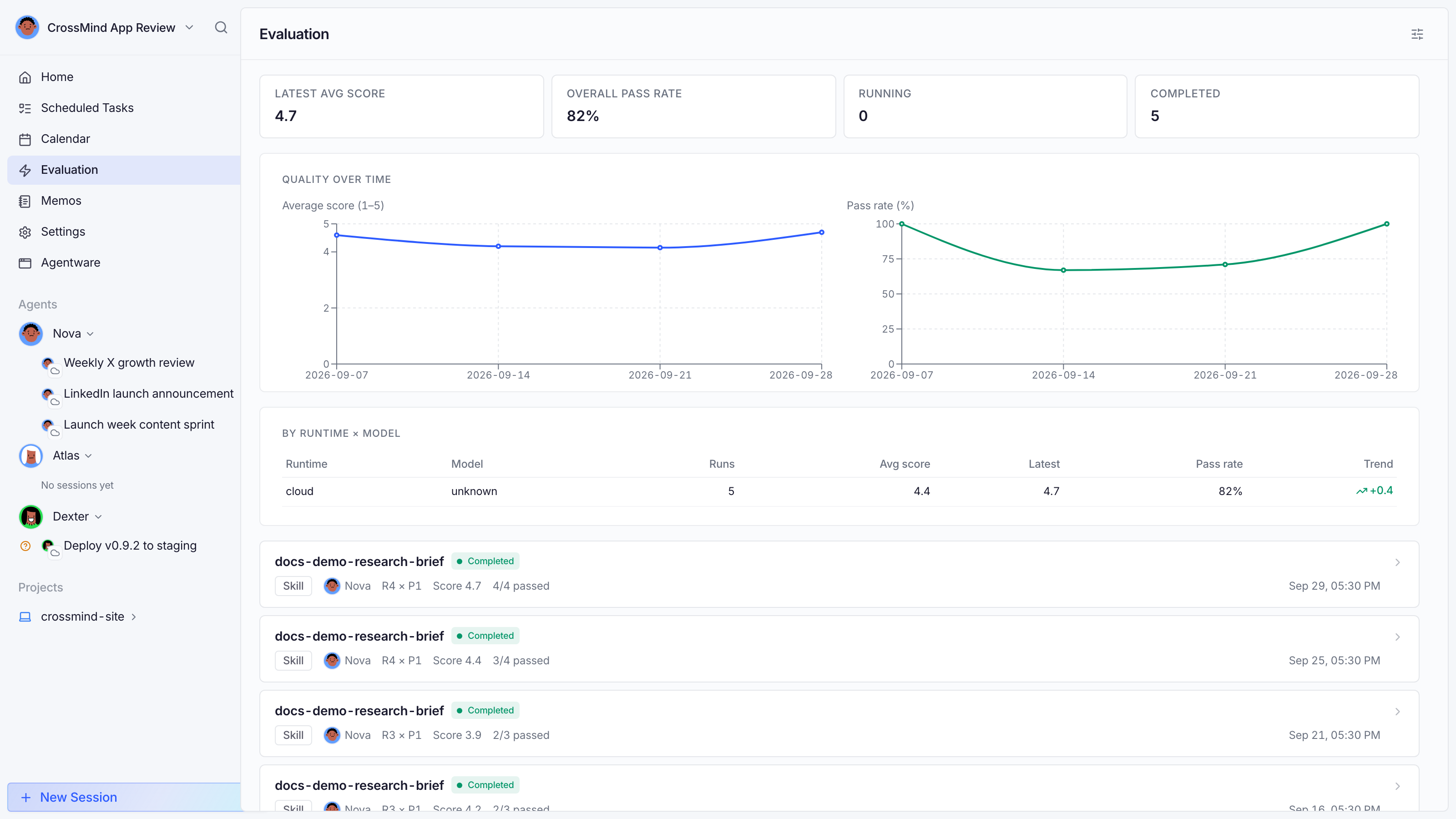
Evaluations answer “is this skill actually good?” with reproducible test runs. An evaluation runs the skill against a set of test cases, scores each round against a rubric, and aggregates the results.
Running one
Section titled “Running one”From an agent’s Skills tab, open a skill → Evaluate. You define:
- Test cases: imported, hand-written, or generated for you.
- Rounds: how many times each case runs (parallelism configurable).
- Rubric: assertions the output must satisfy.
An orchestrator session executes the experiment; every case is a real session so scores reflect actual runtime behavior.
Reading results
Section titled “Reading results”- Trend: average score and pass rate over time, so you can see whether an edit to the skill improved or regressed it.
- Slices: results grouped by runtime × model, with a latest-vs-earlier delta.
- Detail: every round’s transcript is preserved for inspection.
A skill whose evaluation keeps failing is a skill to fix (or retire). The rubric you wrote is the spec.
Quality signals
Section titled “Quality signals”Independently of formal experiments, agents can attach subjective quality signals to their work (self-assessed confidence, debugging notes). Signals never influence dispatch or model selection; they’re an audit trail you can review alongside results. The Evaluation toggle in Labs controls whether agents emit them.