TL;DR: “Why is no one using my app” describes two completely different problems. Acquisition (nobody signed up) is a distribution problem. Activation (they signed up but didn’t come back) is an onboarding problem. Fixing the wrong one first makes everything worse.
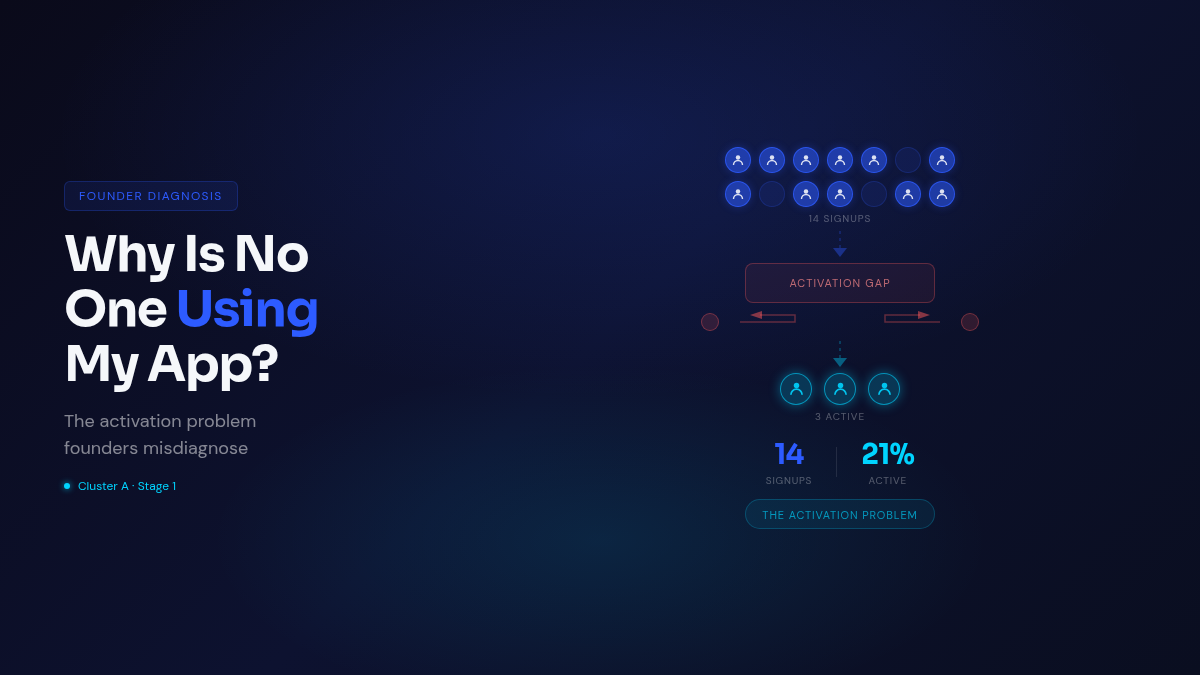
You launched. A handful of people signed up. And then… nothing. The accounts sit there. The dashboard shows they logged in once. Maybe twice. You send an email. Silence.
If you’re asking yourself “why is no one using my app,” the answer almost always falls into one of two buckets, and which bucket you’re in changes everything about what you do next.
Two different problems that look the same from the outside
Acquisition failure: Not enough people signed up. This is a distribution problem. You need more traffic, better channels, a different message in front of the right audience.
Activation failure: People signed up but didn’t come back. This is an onboarding problem. You need to deliver value faster and get users to their “aha moment” before they lose interest.
These two failures look identical from the outside. Your dashboard says “low active users” either way. But the fixes are completely different. Applying the wrong one makes things worse.
If you send more traffic to a product that doesn’t activate users, you get more abandoned accounts. Your retention metrics look broken. Your cost per acquisition rises while paid users stay flat. Getting more people to the top of your funnel only helps if the product actually works once they get there.
Here’s a fast diagnostic: count your total signups. Count users who logged in at least twice in the last two weeks. If you have fewer than 20 signups, you have an acquisition problem, fix distribution first. If you have 20+ signups and fewer than 30% are still active, you have an activation problem.
When nobody uses your app: what activation actually means
Activation is the specific moment a new user first experiences the core value of your product. Not when they create an account. Not when they complete a tutorial. The moment they understand why this exists for them.
For Slack, that moment is sending a real message to a real colleague and getting a reply. For Figma, it’s building something that looks close to what you imagined. For a data tool, it’s seeing an insight from your actual data, not dummy data.
Most founders haven’t defined their activation moment. They assume signup counts. It almost never does. Products where users reach the activation moment within the first session retain roughly 3x more users at 30 days than products that push it to a second or third visit. Lenny Rachitsky’s 2021 activation benchmarks across 200+ SaaS products found consistent patterns here for both consumer and B2B tools.
The question to ask: what is the one thing a new user needs to do (or see) to understand why your product is worth coming back to? If you can’t answer this in one sentence, that’s the first thing to fix.
Why the blank canvas kills activation
The highest-friction onboarding you can design is an empty state. A dashboard with no data. A workspace with nothing in it. A tool waiting for the user to bring something before it can do anything.
We hit this directly. An early user, a founder who’d built and failed with ten previous startups, got access to CrossMind. He opened the app, saw an empty interface, and waited. Three minutes later he closed the tab. Zero PostHog events. No tasks started. No onboarding completed. He wasn’t disinterested. He was exactly the person the product was built for. The empty canvas just had no pull.
We rebuilt the Onboarding flow completely. Instead of showing an empty workspace, users now enter a URL and a one-line product description. Within 30–40 minutes, they get back a real research output: specific Reddit threads where their target users are active, Twitter accounts in their space, a community map of where their ICP actually congregates. They see something concrete and specific to their product before we ask them to pay.
Activation jumped. Not because the product fundamentally changed, but because users could see what it did within the first session, using their actual context.
Three questions to diagnose why users aren’t coming back
Before rebuilding anything, answer these honestly:
1. How long does it take a new user to reach your activation moment?
Time it yourself, as if you know nothing about how the product works. If it takes more than one session to see meaningful value, most users won’t make it. Ideal: valuable within 5–10 minutes. Red flag: requires setup, configuration, or data import before anything interesting happens.
2. Does your product require the user to bring something before it can show value?
If activation depends on the user uploading their data, connecting integrations, or making a series of choices before they see anything, you’re asking for trust before you’ve earned it. The blank canvas problem shows up at onboarding just as much as at launch. What can you pre-fill? What can you infer? What can you demo using realistic placeholder content?
3. Are you measuring activation rate, or just signups?
If you can only see how many people signed up, not what they did after, you can’t diagnose this. You need to track: what percentage of new signups reach the activation moment within 7 days? That single metric predicts retention better than almost anything else. Install PostHog or Mixpanel and set up one event that fires at your activation moment. Watch it weekly.
The wrong fixes people reach for
When users aren’t coming back, the instincts are almost always the same:
Adding features. More features = more things to try = more reasons to return. This is wrong. More features give confused users more to be confused by. Activation is about the core value, not the surface area.
Rewriting the landing page. Maybe they misunderstood what the product does. Possible, but usually not the primary problem. A user who signed up understood enough to sign up. The issue is what happened after.
Email re-engagement campaigns. “Hey, you haven’t logged in lately, here’s what you’re missing!” These underperform because they’re asking users to return to a product that didn’t give them a reason to stay in the first place. Fix the onboarding first. Then re-engagement emails actually work.
What to actually change
Shorten the path to value. Map every step between signup and your activation moment. Mark each step as required or optional. Remove every optional step. If you have 6 steps, see if you can get there in 3.
Remove empty states. Find every screen that shows nothing by default and add something useful there. Example data that looks real. A pre-configured workflow the user can edit. A prompt that starts the first important action automatically.
Define and track one activation metric. Pick the action that represents your core value. Not “viewed the dashboard.” Not “completed profile.” The thing that makes users understand why they should come back. Track how many new users hit it within 48 hours.
Do the onboarding yourself. Create a brand new test account and go through it as if you’re a stranger to the product. Time how long it takes. Notice every moment of friction. Most founders find it takes 2–3x longer than they thought.
Once activation is working and users reliably reach that first moment of value, then scale acquisition. Finding where your users actually are pays off a lot more when the product keeps them once they arrive.
The “nobody’s using my app” problem is solvable. But only if you’re solving the right version. Activation and acquisition need completely different work, and doing them in the wrong order wastes the momentum of a real launch.
CrossMind’s approach to this: we show you the research output before asking you to pay. That’s not a sales trick. It’s how you solve the activation problem for a product that finds users. You can see how that research loop works here.