TL;DR: “Post everywhere” isn’t a strategy. Early adopters cluster in specific communities by pain point, and the channel that works depends entirely on who you’re targeting. Here’s the framework we used to map where our users actually were, plus the specific places that worked (and the ones that burned us).
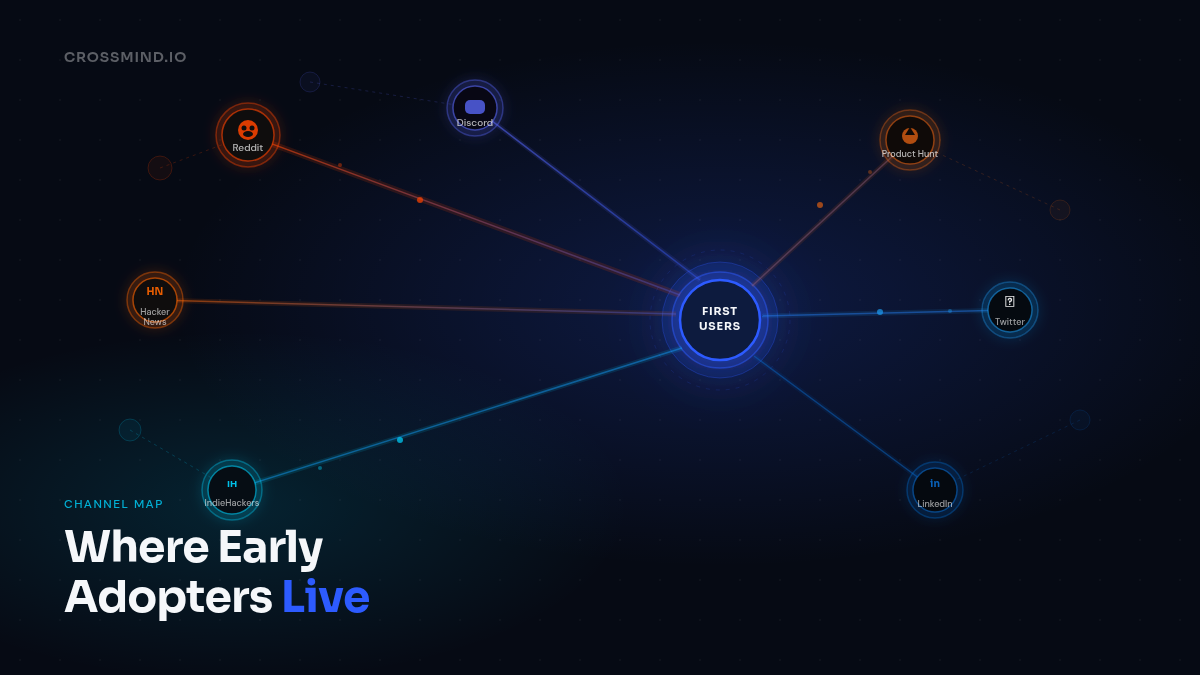
You built something. You posted on Twitter, submitted to Product Hunt, maybe sent a few messages to people you thought might care. Then: nothing, or close to it.
Your users exist. They’re out there complaining about the exact problem you solve, asking for recommendations in communities you’ve never visited. They just don’t know about you.
The gap isn’t your product. It’s knowing where to look.
Why “post everywhere” fails
When you’re early, time and attention are finite. Spreading across 10 platforms and getting nothing from any of them feels efficient, but it’s actually the worst outcome: you generate no signal, learn nothing about which audience responds, and exhaust yourself before you find what works.
Better to find the two places where your specific user is actively experiencing the problem you solve, then go deep there.
That requires knowing who your user is at a precise level. Not “founders” — but “founders who shipped their first product 4-8 weeks ago, are getting almost no organic traffic, and haven’t figured out where their first users will come from.” The narrower you get, the easier it is to find where they cluster.
The five channel categories
| Channel | Start here if | What works | Timeline |
|---|---|---|---|
| Reddit / IH | Your user describes the problem in posts and threads | Comment first, post second; build history before you announce | 4–6 weeks to first real engagement |
| Product Hunt / Fazier / Uneed | You have a soft audience to activate at launch | Pre-launch warm-up; post with context from an existing community | 1-day spike, not compounding |
| Cold DM / cold email | Targeting ≤20 highly specific people with custom messages | Warm sequence: public engagement → follow → context DM | 1–3 weeks per batch |
| Content / SEO | You have something specific and data-backed to write about | Write about the problem, not the product; use real numbers | 90+ days before organic results |
| Niche professional communities | Your user isn’t in “startup” spaces — they’re in their field | Answer questions first; mention product only when directly relevant | 2–4 weeks |
1. Conversation communities (Reddit, Discord, Slack groups, Indie Hackers)
This is where people go to ask questions and complain about specific problems in real time.
Participating in existing conversations before you need anything is what works. The founders who get traction on Reddit aren’t the ones who post “just launched my startup” — they’re the ones who’ve been commenting and answering questions for weeks. When they post about their product, they already have credibility.
Cold posts from new accounts don’t work. Neither do posts that are pure promotion. Reddit is aggressive about detecting low-effort promotional content.
Subreddits worth starting with:
- r/entrepreneur — general founder community, high activity
- r/indiehackers — builders, solo founders, SaaS
- r/SideProject — people launching side projects looking for feedback
- r/startups — earlier-stage company discussion
- r/webdev, r/programming — if your product is developer-facing
The only question that matters for any community: are people here actively experiencing the problem I solve? If yes, you belong there. If not, skip it.
2. Discovery platforms (Product Hunt, Indie Hackers milestones, Uneed, Fazier)
These platforms exist specifically so people can find new products.
Having an existing audience before you launch is what works. PH rewards early engagement, and early engagement comes from people who already know you. Without that base, you’ll get a traffic spike from the platform, then a cliff.
Launching cold with no existing audience rarely delivers the committed early users who give you real feedback. It can work as a traffic catalyst — just don’t count on it for your first cohort.
Uneed.app and Fazier are lower-friction alternatives: less competition, more community engagement per launch, and more forgiving of cold starts.
3. Content SEO (blogs, technical articles, guides)
Long-form content reaches people searching for solutions to specific problems. It’s the slowest channel but the most compounding.
Write about the specific problem your user has, not about your product. “How I mapped where my first users were” is searchable. “CrossMind’s approach to user acquisition” is not.
Don’t expect results in the first 90 days.
The biggest content opportunity early on: you have real data most content marketers don’t. Use it. We wrote about getting 0 replies from 69 cold DMs. We wrote about a user who found us through Reddit in 11.4 hours. That specificity is why those posts get read.
4. Direct outreach (cold DMs, cold email, LinkedIn)
Targeted personal messages to potential users have the highest ceiling (you can get a meeting) and the highest failure rate.
Warm outreach works — to people who’ve already engaged with something you’ve made. They shared a related post, commented on a thread, follow you for a reason. You have a starting point.
Cold outreach at scale doesn’t work. We ran 69 cold DMs and got zero replies. Not a low rate — zero. The issue isn’t the copy. Cold accounts don’t get opened.
If you’re going to try cold outreach, start with 5 highly specific people instead of 50 general ones. A custom message about a specific thing they said is far more likely to get a response than a polished template.
5. Niche communities where your users help each other
Every professional niche has spaces where people give each other advice on the exact problems you solve. These get overlooked because they’re not “startup” communities — but that’s the point. Your user is there being a normal person in their world.
Answering questions genuinely is what works. When someone asks “how do I find my first beta users” in a product management Slack, a useful answer that happens to mention your product is legitimate and welcome.
Mass-posting product announcements in these spaces is not.
How to map your channels
Spend an hour doing this before you start posting anywhere:
-
Write down three specific people who would benefit from your product right now. Not personas — real types of people. Name their situation exactly.
-
For each person, ask: when they hit this problem, where do they go? Do they search Google? Ask in a community? Look for recommendations somewhere?
-
Visit those places and read. Are people already talking about this problem? What language do they use? What do they say when they don’t have a solution?
-
Pick the two with the most activity around your specific problem. Those are your starting channels.
- Pass: You named a specific community, read at least 20 posts there in the last week, and found 3+ posts where your exact user describes the exact problem you solve.
- Stop here: You picked a platform (“Reddit”) but not a community. Or you picked a community but haven’t read it yet. Posting now means posting in the wrong place.
This took us about a week of reading before we understood where our users were. That research produced a specific list of Reddit communities and Twitter accounts we hadn’t known about before.
What changed when we found the right channel
Our first user from a stranger came through Reddit. Sahil found one of our posts in r/Entrepreneur in 11.4 hours and signed up without any direct outreach from us.
Not through a cold DM. Not through Product Hunt. Through a post in a community where he was already spending time, already frustrated by the problem we solve.
The channel wasn’t magic. It was just the right channel for that specific audience. He was in a community of founders actively looking for distribution solutions, and we happened to be there too.
That’s the whole job of channel selection: being in the right place when your user is already looking.
Channels not worth your time early on
Twitter for launching: Your followers see your posts. 200 followers means 200 people. The algorithm doesn’t surface new products to non-followers.
Cold mass outreach: 0% is where this converges for most founders without existing relationships.
Press outreach: Journalists cover products with users. You need users first, then press becomes an amplifier. In reverse order, it rarely works.
Building an audience from scratch before launching: Right in theory, painfully slow in practice.
The starting question that actually helps
Most founders ask “where should I post this?” The better question is “where is my user right now, looking for something like this?”
Those questions lead to different places. The first leads to launch platforms. The second leads to the communities where your user is already active, describing their problem in their own words.
The channel analysis we did on Reddit vs cold DMs showed a 100x difference in engagement between the two approaches. Not because Reddit is better in general — because Reddit had the community with the right problem at the right time.
That specificity is the whole job.
CrossMind’s Onboarding does the channel-mapping step in 40 minutes — which specific subreddits and X accounts your ICP is in, which threads are active now, and a first-week execution plan. You see the map before you’re asked to pay. Find where your users are →