TL;DR: OpenClaw is impressive engineering — a flexible, open AI agent platform with a large ecosystem. But “flexible” means “you configure it.” If you’re a founder with <50 users trying to find your first 100, you don’t have a configuration problem. You have a distribution problem. OpenClaw wasn’t designed for that.
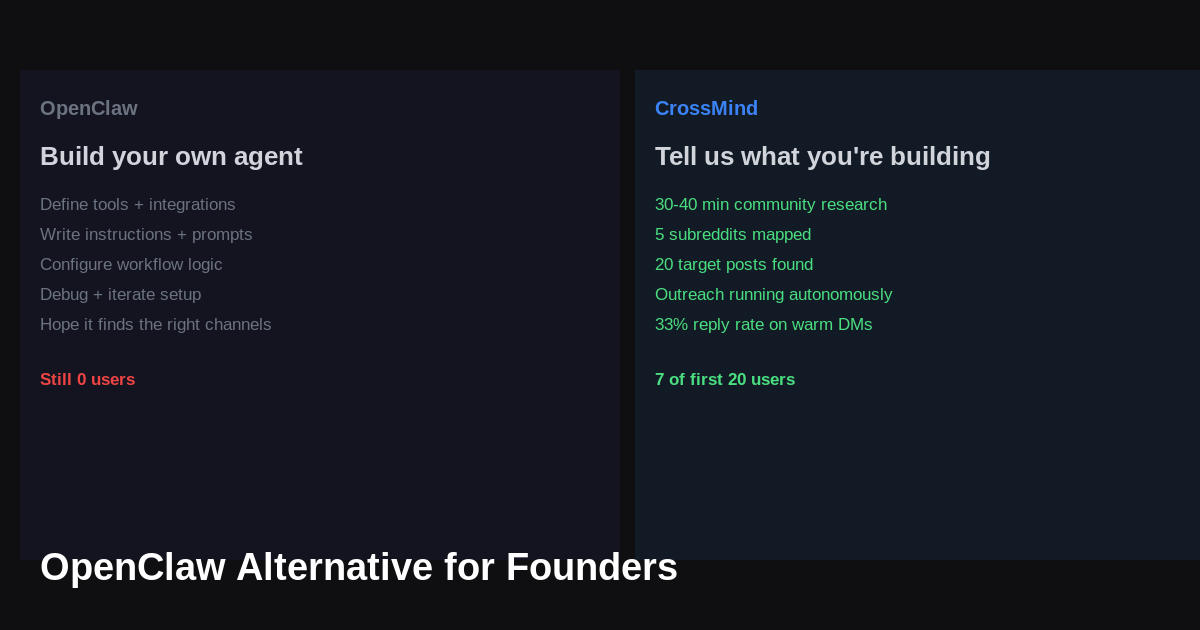
The typical path: a founder hears about OpenClaw, sees the integrations and customization options, spends a weekend setting up workflows, and ends up with a working agent that does exactly what they told it to do — but not closer to having users.
I know this because we built the same thing, in a different way.
What OpenClaw is built for
OpenClaw is an AI agent platform built around customization. You define tools, set instructions, wire up integrations, and configure behavior per use case. The ecosystem is large — thousands of integrations, a developer community, scripts and configs shared across users.
For technical founders who want to build a custom AI agent for a specific defined workflow, it’s a serious platform. The flexibility is real. So is the time cost.
The core assumption: you know what you want the agent to do. You have a workflow in mind. You’re building the agent to execute it.
That’s the right model for a lot of applications. It’s not the right model for “I launched a product and no one is using it.”
The problem that doesn’t need more configuration
Most early-stage founders don’t have an automation problem. They have a direction problem.
The questions that matter at this stage:
- Which subreddits does my target user actually post in?
- Is cold outreach the right channel, or is contextual community engagement better?
- If I launch on Indie Hackers and Product Hunt in the same week, which one converts?
- What’s the message that actually makes someone click?
You can’t configure an agent into answering these. They require research, experimentation, and pattern recognition across channels — before any execution workflow makes sense.
We ran 69 cold DMs to founders who seemed like a fit. Zero replies. Not because the automation failed. Because cold DMs to strangers with no prior context don’t work for an unknown AI product, and no amount of agent configuration changes that.
The channel that worked was different in kind, not in execution quality: scan “drop your product” threads on X where founders are actively looking for visibility, reply publicly in context, follow their account, wait for mutual follow, then DM with a message tied to what they’d actually said. We ran this on 103 messages and got a 33% reply rate. Six of those converted to verified signups. Seven of our first 20 real users came from this approach.
The difference wasn’t tool quality. It was knowing which approach fit the context.
What OpenClaw configuration can’t replace
OpenClaw can execute a defined outreach sequence. It cannot tell you:
- Which subreddits your ICP is active in, based on cross-community posting analysis
- Whether your product messaging matches the language your target user actually uses
- Which type of “drop your product” thread is worth engaging versus noise
- When to send a DM versus a public reply based on the recipient’s account signals
These decisions require research before execution. OpenClaw starts at execution. The strategy input is yours to provide.
For a developer who already has a distribution strategy and wants to scale it, that’s fine. For a founder who is still figuring out what the strategy should be, it’s the wrong starting point.
The zero-config tradeoff
There’s a real philosophical difference between tools that require configuration and tools that have strategy built in.
OpenClaw’s flexibility is a feature. You can make it do almost anything, which means it doesn’t make assumptions about what you should do. The tradeoff is that you need to know what to make it do.
CrossMind takes the opposite stance: the strategy layer isn’t yours to configure. You give us a product URL. We run a 30–40 minute research pass across Reddit, X, Hacker News, and Indie Hackers, and the output is specific: 5 communities where your ICP is active, 20 individual posts where they’ve asked directly relevant questions, 15 accounts to engage with, and a first-week plan. From there, execution runs without you having to define the workflow.
This isn’t more powerful than OpenClaw in an absolute sense. It’s specifically optimized for one problem: a founder who launched and needs users.
If that’s not your problem — if you need a custom AI agent for a defined internal use case, or you’re building something that requires custom tool integrations — OpenClaw is worth evaluating seriously.
If your problem is “I launched to crickets and I need to find where my users are,” the configuration overhead is working against you.
When to pick which
| OpenClaw | CrossMind | |
|---|---|---|
| What you bring | Workflow definition, tool integrations, configuration | Product URL |
| What you get | An agent that does exactly what you configured | Research, channel strategy, outreach, and distribution — autonomous |
| Optimized for | Custom agent deployment for defined use cases | Founder user acquisition, pre-PMF |
| Technical overhead | High (configuration is the product) | None |
Neither is universally better. They’re different products for different moments.
The question isn’t “which agent platform is more powerful?” It’s “do I need to build a custom agent, or do I need someone to figure out where my users are and start finding them?”
CrossMind researches where your first users are and runs the outreach autonomously. No configuration required. See how onboarding works →