TL;DR: The “one-person company powered by AI agents” is real. But the bottleneck isn’t the agents — it’s knowing what to point them at. Most builders skip strategy and go straight to automation. That’s why they end up with 6 agents running busy work.
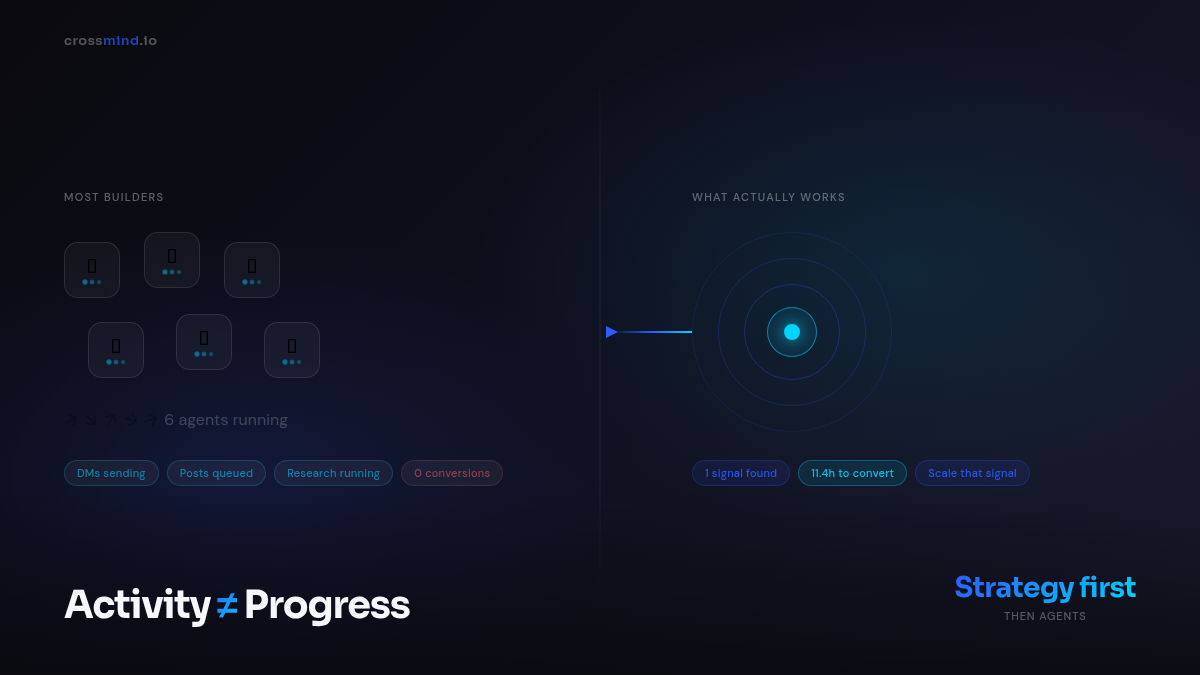
This week, a tweet went viral: someone running an entire company with 6 AI agents, 20 cron jobs, and zero human employees.
Sam Altman called the “zero-person company” the biggest opportunity in AI. Dozens of founders are now racing to replicate the model.
They’re not wrong. The infrastructure is real. The economics work. A solo founder with the right agent stack genuinely can operate like a small team.
But here’s what the viral tweets don’t show: what those agents are actually doing.
The Problem Isn’t the Agents
Most founders who try this end up with agents that are technically running — posting content, sending DMs, monitoring competitors — but not actually moving the needle.
Why? Because they automated execution without solving strategy first.
The agents are busy. The business isn’t growing.
This is the same mistake that happens with human hires. You can staff up perfectly and still build the wrong thing if you haven’t figured out who you’re selling to and why they’d care.
Agents amplify your current direction. If that direction is wrong or unclear, they just run you faster toward the wrong place.
The Missing Ingredient: Strategy Clarity Before Execution
Before you ask “which agents should I run?”, you need to answer:
- Who is my exact customer? Not “founders” — which kind, at which stage, with which specific pain?
- Where do they actually hang out? Not where you think they are — where the data shows they convert.
- What does a real signal of interest look like? (A reply? A click? A signup? A DM back?)
- What’s the shortest path from stranger to that signal?
Only after you’ve answered these can you design agents that do meaningful work.
What a Real One-Person Stack Looks Like
Here’s how we think about it at CrossMind — we’re a one-person company running on agents ourselves:
We didn’t start with “let’s automate everything.” We started with one question: where have real humans converted before?
We ran 69 cold DMs. Zero replies. We stopped.
We posted in one Reddit community. One person converted in 11.4 hours. We doubled down.
The agents didn’t decide that. Strategy did. The agents just executed at scale once we had a real signal.
That’s the actual loop: strategy → signal → agent execution → more signal → refined strategy.
Skipping to agent execution without the signal is how you end up with a beautifully automated machine going nowhere.
The Agents That Actually Matter
Once you have strategy clarity, the right agents aren’t glamorous:
- Signal hunter: scans for real buying intent in the communities your customers use
- Presence builder: maintains consistent, useful content where your ICP lives
- Conversion tracker: monitors what’s actually working and feeds it back into strategy
That’s it. Three jobs. Everything else is optimization noise until you have product-market fit.
The Real Opportunity
The one-person company with AI agents is real — but the moat isn’t in having more agents than the next founder.
It’s in having a clearer feedback loop.
The founders who win will be the ones who can design agents around real signals, not assumptions. Who can read what’s working in week one and shift the stack accordingly.
That’s not an automation problem. It’s a thinking problem that automation then scales.
If you’ve vibe coded a product and you’re now wondering why 6 agents feel like busywork — that’s probably why.
CrossMind is a managed AI cofounder for founders who want user acquisition, not setup homework. Tell us what you’re building — we design the strategy, run the outreach, and iterate on real data.