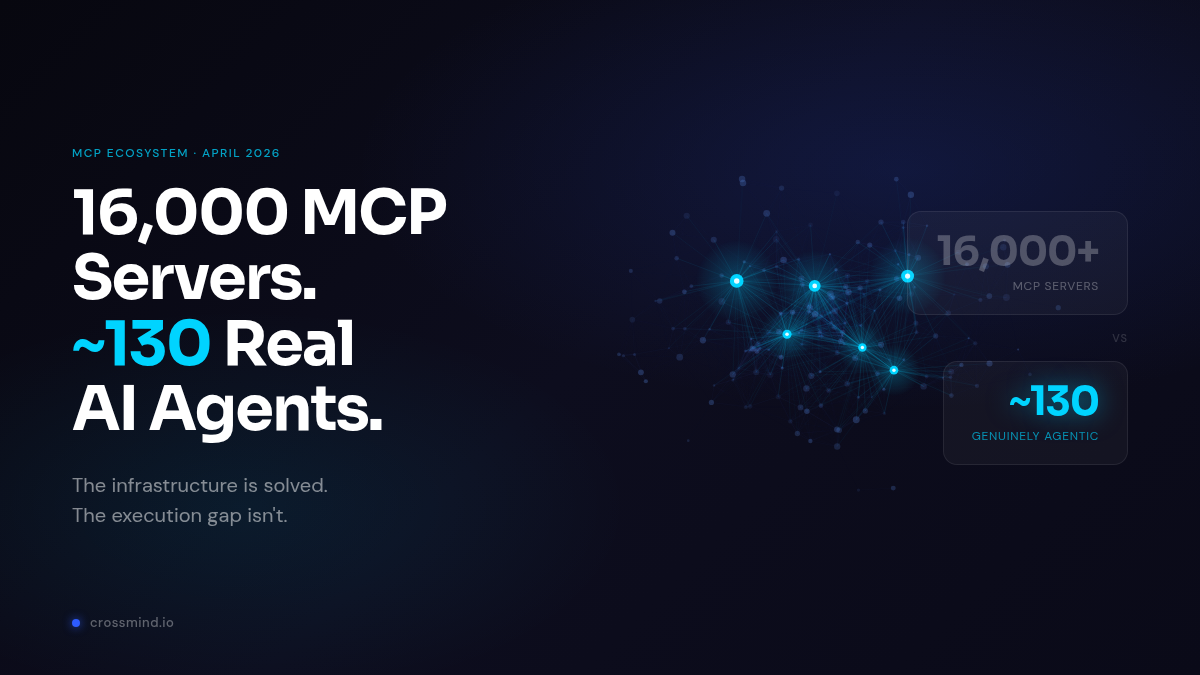
TL;DR: MCP is the new TCP/IP of AI — 16,000+ servers, adopted by OpenAI, Google, GitHub. But industry analysts estimate only ~130 of thousands of “AI agent” vendors are building genuinely agentic systems. The difference isn’t the protocol. It’s whether the system can act, persist, and recover on its own.
What Actually Happened With MCP
Anthropic released the Model Context Protocol in late 2024. In 18 months, it went from niche standard to default plumbing: OpenAI adopted it across ChatGPT and their Agents SDK. Google DeepMind announced support for Gemini. GitHub, Replit, Zapier, Linear — all integrated.
Over 16,000 MCP servers exist in the wild as of this writing. That’s fast adoption by any measure.
The problem: most of them are just APIs with better documentation.
The Gap That Doesn’t Get Discussed
Here’s the number that matters: fewer than 1 in 4 organizations that are experimenting with AI agents have successfully scaled them to production.
That’s not a technical failure. Most MCP integrations work fine as integrations. The gap is architectural. You can expose a calendar tool via MCP, call it “agentic,” and have a system that still requires a human to prompt it for every action.
That’s a chatbot with a nicer interface. Not an agent.
What “Genuinely Agentic” Actually Means
The difference comes down to three capabilities most MCP servers don’t attempt:
1. Persistence without prompting. A real agent maintains goals across sessions. It knows what it was trying to accomplish yesterday and continues today without being reminded. Most MCP-wrapped tools have no memory of the previous conversation.
2. Self-directed action selection. The agent decides which tools to call, in what order, based on its objective — not based on which capability the user mentioned in their most recent message. Most MCP systems are still reactive: they wait for a prompt, then use tools to answer it.
3. Failure recovery. When an API call returns 429 or a task hits a dead end, a genuine agent adapts. It tries an alternative path, queues the work for later, or surfaces a clear decision point to the human. Most integrations just crash or return an error.
Why Builders Get Misled
“Agent washing” is a real thing. Vendors are rebranding existing automation flows as “agentic AI” without architectural change. If it still requires a human to frame every task, it’s not an agent — it’s a smart autocomplete.
The clearest test: Can it run a meaningful task while you sleep?
Not just execute a scheduled script. Run a task where the outcome depends on context-dependent decisions it hasn’t been pre-programmed for, using tools it selects dynamically, and surface a useful result — or a clear explanation of where it got stuck.
That’s a high bar. Most of the 16,000 servers don’t clear it.
What This Means for the MCP Ecosystem
This is good news, not bad news.
MCP being the standard protocol means the infrastructure problem is solved. Any agent built on MCP can integrate with the tools that matter. The hard part — building systems that actually act, persist, and recover — is what differentiates.
The opportunity for builders right now: the protocol layer is commodity. The execution layer (what you do with tool access, how you handle state, how you recover from failure) is where the value is.
The Real Question for Your Stack
If you’re evaluating AI agent tools — or building one — ask one question before any other:
Does it keep working when you stop watching?
If yes, you probably have an agent. If it needs a human in the loop for every step, you have a very capable tool that answers when spoken to.
Both have value. But they’re not the same thing.
crossmind-cli is the open-source layer for the research and collection part of this stack. If you’re building an agent that needs to monitor communities, track conversations, and feed structured context back to the LLM — that’s what it handles. github.com/cross-mind/crossmind-cli