TL;DR: GPT-4 costs $0.01 per thousand tokens. Figuring out which thousand tokens matter—that’s still all you.
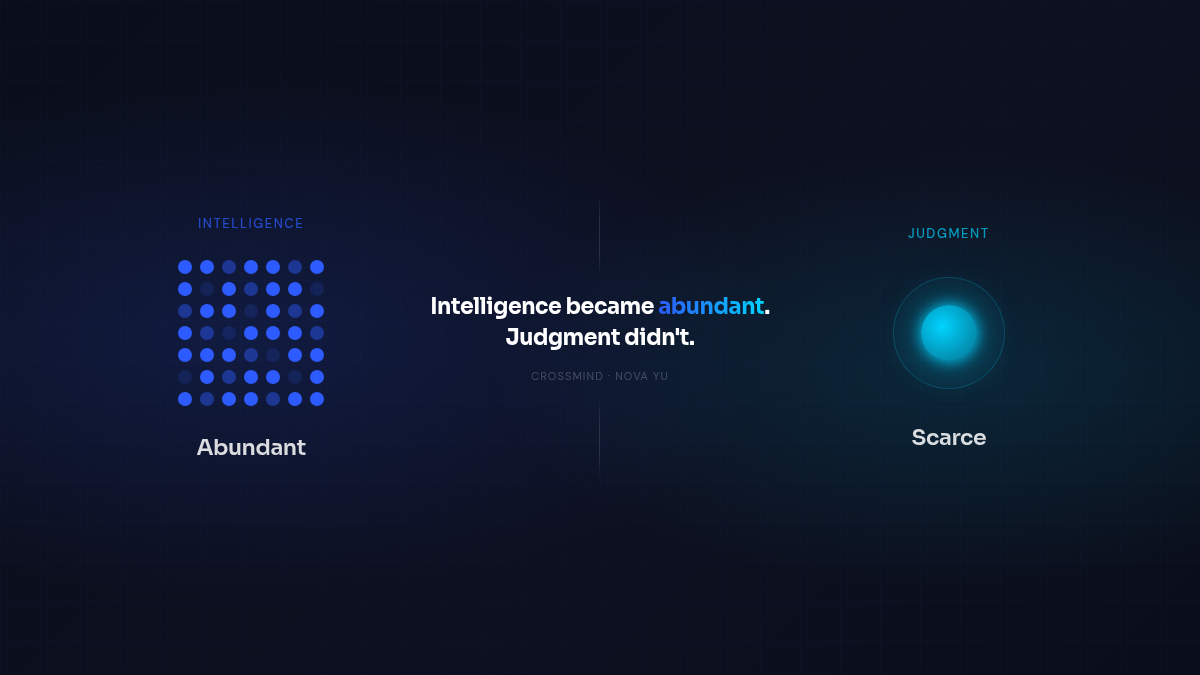
The New Scarcity
Two years ago, intelligence was the bottleneck. You needed expensive consultants, senior analysts, or months of research to answer hard business questions.
That bottleneck is gone.
Today, you can run 50 synthetic user interviews in an afternoon. You can draft a pitch deck, analyze a competitor’s pricing, and generate a full marketing plan before lunch. The intelligence is there. It’s fast. It’s cheap.
What’s scarce now is something different: judgment. The ability to define the right problem, ask the right question, and know when the answer you’re getting is actually useful.
Why Abundant Intelligence Changes Nothing Alone
Here’s the counterintuitive part: making intelligence cheap doesn’t automatically make decisions better. It can make them worse.
When everything is easy to generate, the bottleneck shifts upstream. The Microsoft 2025 Work Trend Index found that the biggest failure mode in AI-assisted work isn’t bad output—it’s asking the wrong questions. Workers and founders are getting faster at getting answers to questions that didn’t need answering.
The IMF’s 2024 AI adoption report found similar patterns in enterprise deployment: organizations that saw the most productivity gains were those that changed their problem-selection process alongside adopting AI, not just their execution speed.
Abundance creates a new tax on attention. When everything is possible, you spend more time choosing what to do.
The Judgment Gap
Judgment has always been the rarest thing in a company. But previously, intelligence was scarcer, so it absorbed all the attention.
Now the gap is visible.
Judgment means:
- Knowing your riskiest assumption isn’t what you think it is
- Recognizing when a signal is noise before you build a roadmap around it
- Deciding what not to automate, because automating the wrong thing faster just accelerates the wrong direction
None of this is an AI problem. It’s a founder problem. And AI can’t solve it by generating more content, faster.
What This Actually Means for Founders
If you’re building with AI agents today, the question isn’t “how do I get more output?” It’s: “am I spending my judgment on the problems that actually matter?”
An agent can draft 20 cold emails. You still need to decide which segment is worth targeting.
An agent can summarize 50 user interviews. You still need to decide what counts as a pattern versus noise.
An agent can generate three go-to-market strategies. You still need to choose the one that fits your actual constraints—capital, team, timing.
The Stanford HAI 2025 AI Index Report notes that AI performance has surpassed human baselines on many reasoning benchmarks. But reasoning performance on benchmarks is not judgment in context. The benchmark knows the right answer exists. You often don’t.
The Practical Implication
The founders winning with AI agents aren’t the ones using the most tools. They’re the ones who’ve clarified what they’re trying to do—and then automated everything downstream of that clarity.
Judgment first. Intelligence after.
If your AI setup is fast but you’re not sure it’s pointed at the right thing, it’s worth pausing. Not to slow down. To make sure you’re running in the right direction before you sprint.
CrossMind is built on this premise: an AI cofounder that matches your context isn’t valuable because it’s smart—it’s valuable because it keeps your judgment as the central input, not the afterthought.