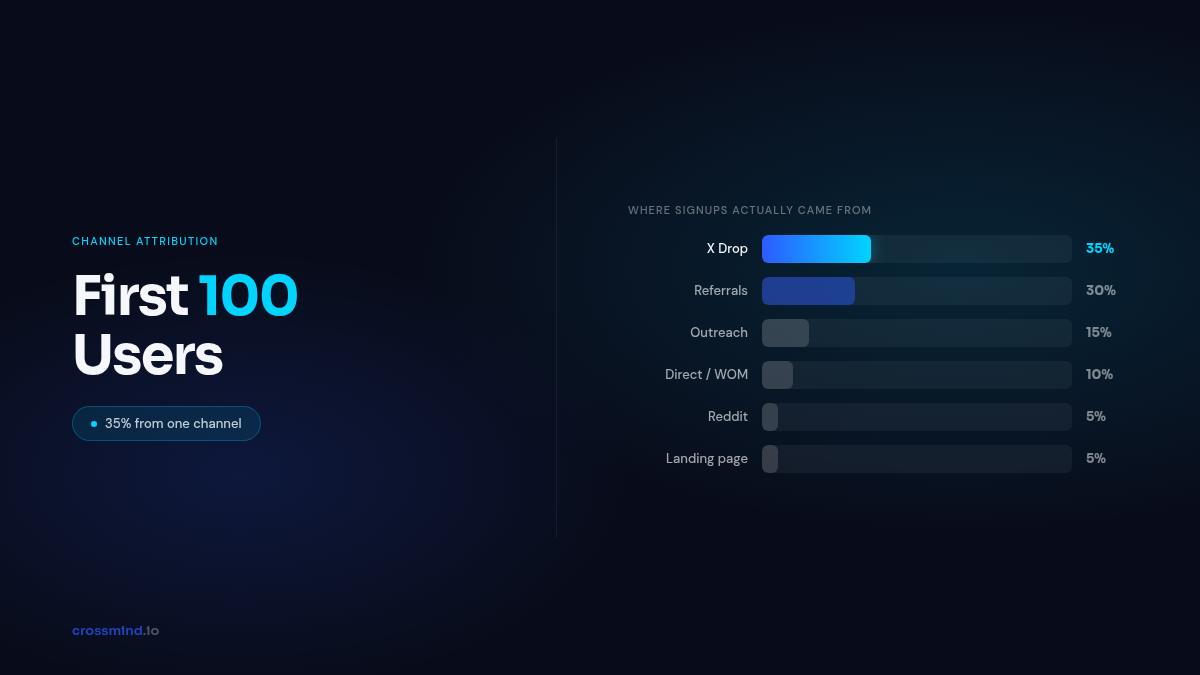
TL;DR: We tracked every non-team signup to its source. 35% came from one channel nobody tells you to use. 30% came from personal referrals, which are fast but don’t scale. The channels every blog post recommends? They drove less than 5% combined. Here’s the complete attribution.
Most advice about getting your first 100 users tells you to post on Product Hunt, cold DM influencers, and launch on Indie Hackers. That advice isn’t wrong. It’s just missing the part that matters: what the actual numbers look like.
We decided to track ours.
The real attribution breakdown
Every startup advice post tells you where to try. Almost none show you what actually worked with real numbers attached. Here’s ours, after tracking every non-team signup across six months:
| Channel | Users | Share |
|---|---|---|
| X Drop Pipeline | 7 | 35% |
| Direct referrals | 6 | 30% |
| Prospect outreach | 3 | 15% |
| Direct app link (warm word-of-mouth) | 2 | 10% |
| 1 | 5% | |
| Landing page organic | 1 | 5% |
The last row is worth pausing on. Our landing page, the thing we iterated on most, generated one signup in six months. That user used a disposable email. They never came back.
The channel that scaled (and why nobody talks about it)
Seven of our first 20 users came through what we call the X Drop Pipeline.
The mechanic: monitor “drop your product” and “what are you building” threads on X. Founders who post in those threads are self-selecting. They have a product and want people to see it. That’s our exact ICP at the moment they’re most likely to respond.
We didn’t cold DM them. We replied publicly to their posts first, then followed, waited for a mutual follow, then sent a single context-specific message. That sequence drove roughly a 33% reply rate.
Compare that to our earlier approach: identical product, identical platform, skip the public engagement step, go straight to DMs. Result: 0% reply rate across 69 attempts.
Same channel. Different entry point. The public reply to mutual follow to warm DM sequence took more steps, but each step filtered for genuine interest. By the time we sent the DM, the person already knew who we were. The full A/B breakdown explains exactly how the reply rates differed and why.
The scalable part: these threads aren’t something you post in once. New ones appear daily. The founders in them are a steady pool of people actively looking for visibility, which is exactly what makes them worth monitoring consistently.
The channel that worked but has a ceiling
Direct referrals: 6 users, 30% of our early base.
This is the uncomfortable number. Personal introductions converted almost every time because they came pre-trusted. But they require your time and your relationships, which means they don’t scale past the first 20-30 users without burning through everyone you know.
The real role of referrals in early growth: they buy you time to find what actually scales. Get 10-15 users through your personal network quickly, and you have enough usage data to understand which channels to invest in next.
Don’t confuse referral traction for a distribution strategy. Founders who stall at 30-50 users often got there through referrals and then hit a wall because they never developed a channel that didn’t depend on them personally. That wall is the real problem, not a lack of effort.
Reddit: low volume, high quality
One signup from Reddit doesn’t sound like much until you look at the signal quality.
That user found us through a comment thread in r/Entrepreneur, had a real email address, and engaged with the product in the first session. Conversion happened in 11.4 hours from first contact to signup, faster than any other channel we tracked.
Reddit’s conversion rate per impression is higher than almost anything else we tested. The problem is volume: you need the right subreddit, right thread timing, and genuine participation rather than broadcast posting. How to navigate Reddit without getting shadowbanned goes deeper into subreddit selection and what “participating” actually looks like versus promoting.
The other signal worth noting: our channel analysis showed clearly which platforms actually convert for our ICP versus which ones feel productive but don’t move the number.
The launch channels: what we actually got
We submitted CrossMind to launch directories and community platforms, prepared Product Hunt assets, posted on Indie Hackers, and tracked inbound from launch-day traffic.
The result: visibility spikes that didn’t compound into signups.
This isn’t a reason to skip launches. Comparing Indie Hackers, Reddit, and Product Hunt found each has a distinct use case. But none of them work well as your first acquisition attempt. They amplify existing signal; they don’t create it.
Founders who get real traction from Product Hunt launches already have an engaged audience to activate. They’re not launching cold.
How to choose your first channel
Based on where our users actually came from, the decision rule is simple:
Where is your ICP self-selecting?
Founders posting in “drop your product” threads have already signaled intent. Reddit users describing a problem in your category have signaled pain. Cold audiences (landing page visitors, cold DM targets) have given you no signal at all.
Where to find early adopters across platforms is a complete channel map for different ICP types. The underlying logic is consistent: find where your ICP goes when they’re already thinking about your category, and show up as a participant first.
The sequencing mistake is launching before doing this work. Build a landing page, post an announcement, wait. The problem isn’t the channel; it’s the order. Broadcasting works after you’ve built context. It almost never works cold.
The practical checklist
If you’re targeting your first 100 users:
-
Start with direct referrals. Talk to every founder you know who fits your ICP. Collect real feedback fast. Don’t mistake this for a distribution strategy; it’s a signal-gathering phase.
-
Find where your ICP self-selects. Which subreddits do they post in when frustrated? Which X threads? Which communities? Discord communities for founders explains why some community channels don’t work the way people expect. The platform matters less than whether the community has the behavior you need.
-
Engage before asking. Reply publicly, build familiarity, then reach out. The extra steps aren’t overhead; they’re what changes a cold ask into a warm one.
-
Track every signup to its source. You don’t need fancy tooling. A spreadsheet and “how did you find us?” at signup is enough. If you hit user 50 without knowing where users 1-20 came from, you’re optimizing blind.
-
Double down on what converts, not what feels like progress. Writing landing page copy feels productive. So does posting in every community. Neither matters if you can’t trace signups back to the activity.
The honest version
Getting to 100 users is mostly a research problem disguised as a marketing problem.
You’re not trying to reach everyone who could use your product. You’re trying to find the 100 people who are already looking for something like it. The channel question is really: where do those people go when they’re actively looking?
For CrossMind, the answer was X Drop threads. Founders who raised their hands. Not people who passively visited our landing page, but people already saying publicly: I have a product, I want users.
That’s the channel that worked.
CrossMind researches where your users are, which communities, which threads, which accounts, and handles the first round of outreach. Start with your URL.