TL;DR: The best time to find beta users is eight weeks before launch, not the day after. Most founders post once on Product Hunt and wait. The ones who get real feedback start building a pipeline from Reddit and niche communities months early. Here’s the framework, with data from what actually worked.
Why Most Founders Find Zero Beta Users
The default move is: build product, launch on Product Hunt, tweet “just launched!”, wait. Then wonder why nobody shows up.
We did exactly this. Our first launch got a handful of upvotes from friends and zero real users. The problem wasn’t the product. The problem was that we started looking for users after we’d already built the thing. Nobody was waiting for us.
Beta users aren’t hiding. They’re in specific communities talking about the exact problem you’re solving. But you have to find them before you need them, not after.
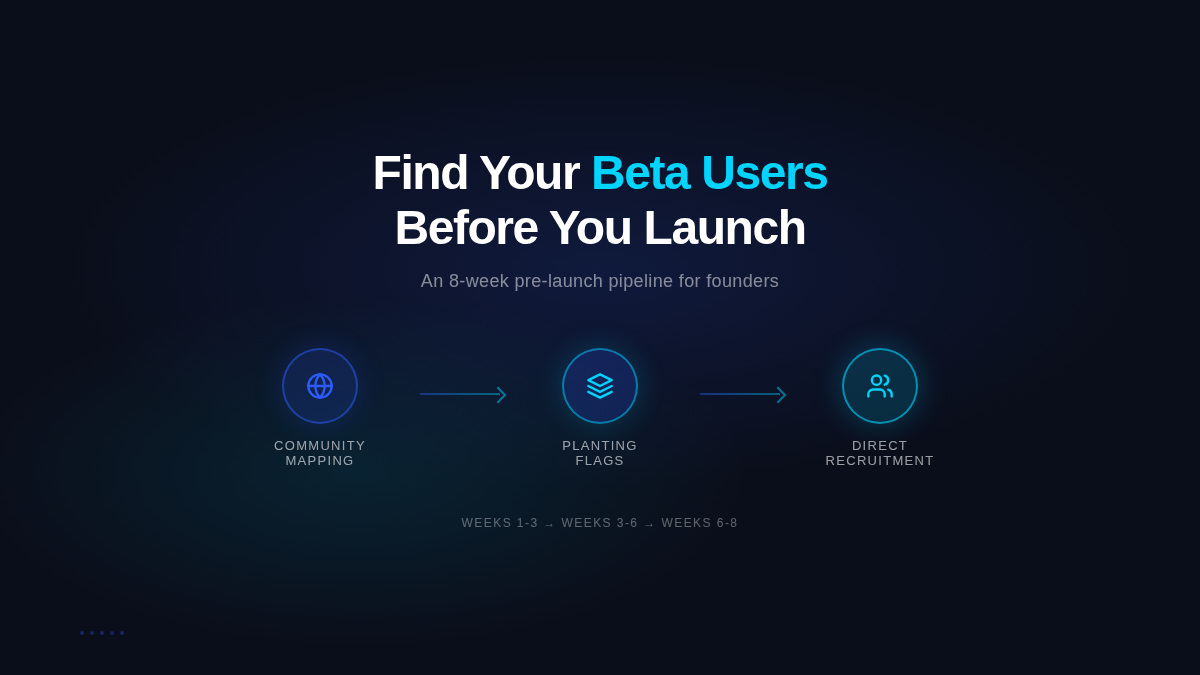
The Pre-Launch Beta Pipeline (8-Week Framework)
Here’s what we do now, in three phases.
Phase 1: Community Mapping (Weeks 1–3)
Before you write a single line of code, map where your potential users hang out. Not where you think they are. Where they actually are.
For developer tools: r/webdev, r/SideProject, IndieHackers, specific Discord servers (Cursor, Replit, Vercel), DEV.to
For consumer products: Subreddits around the specific problem (not generic startup subreddits), Facebook Groups (still surprisingly active for non-tech demographics), niche forums
For B2B: LinkedIn communities, industry-specific Slack groups, Twitter/X communities around the job title
The mapping exercise itself takes about 30 minutes if you’re systematic. Search for your core problem phrase on Reddit (“distribution problem founder”, “launched to crickets”, “no users after launch”) and note which subreddits come up. Those are your targets.
We use a two-axis framework: builder toolstack communities (where people like you hang out) and problem-domain communities (where your users’ problems get discussed). If you’ve already launched and feel stuck, the distribution checklist we published covers the post-launch diagnosis.
Phase 2: Planting Flags (Weeks 3–6)
Create accounts in every community you mapped. Don’t post about your product yet.
Instead:
- Answer questions related to your problem space
- Share useful resources (not yours)
- Comment on other people’s launch posts
- Upvote genuinely interesting projects
This does two things. First, account credibility, so you don’t look like a spammer when you eventually post. Second, you learn what people actually struggle with, which is not what you’d guess from the outside.
We spent three weeks in Reddit and IndieHackers before our first product mention. During that time, we learned that founders don’t say “I need a growth tool.” They say “I launched and nobody came.” That language difference shaped our entire channel research strategy.
Phase 3: Direct Recruitment (Weeks 6–8)
Now you’re ready to find beta testers directly.
Method 1: Community posts. Post in r/AlphaandBetausers, r/SideProject (with a genuine ask, not a marketing pitch), and IndieHackers. Frame it as “I’m building X to solve Y, looking for 10 people to try it and tell me what’s broken.” Specific number, specific ask.
Method 2: DM people who expressed the pain. Go back through your community mapping. Find people who posted about the exact problem you solve. DM them with a two-sentence note: “Saw your post about [problem]. I’m building something for that, want to try it and tell me if it’s useful?” We tested DM outreach at scale (69 messages) and got a 0% reply rate. The difference here is context. You’re responding to a specific public complaint, not cold-pitching strangers. Still, keep expectations modest. Community-based discovery beat cold DMs by a wide margin.
Method 3: Launch directory submissions. Submit to BetaList, Fazier, Uneed, and AlternativeTo. These have small but targeted audiences actively looking for new tools. We submitted to multiple directories in a single day and the process itself was useful. Each directory forced us to sharpen our one-liner. The unglamorous details of that process are here.
The Channels That Actually Worked (Ranked)
Based on two months of active user acquisition:
-
Reddit (specific subreddits, not generic ones). Our first real user came from r/Entrepreneur after 11.4 hours of posting. Reddit works when you match the right community with the right framing. Not “check out my product” but “I built this because I had the same problem.”
-
IndieHackers. Good for longer-form posts. The audience is builders who understand the grind. Conversion is slow but trust is high.
-
Launch directories. Low volume, but the users who come through are actively evaluating tools. Fazier and Uneed sent us a handful of signups each.
-
Cold DMs. Dead last. 69 attempts, zero replies. The channel is saturated and the trust isn’t there.
What to Ask Beta Users (And What Not To)
Don’t ask: “What do you think?” (you’ll get polite lies) Don’t ask: “Would you use this?” (hypothetical yes means nothing)
Ask: “What’s the last thing you tried to solve this problem?” Ask: “Can you show me how you’d use this right now?” Ask: “What would make you stop using this after today?”
Beta users who don’t come back after Day 1 are telling you something. Our own data showed that 4 out of 6 registered users got stuck in the first step and never activated. That feedback is more valuable than a hundred “looks great!” comments.
How We Automate This Pipeline Now
We eventually automated the community research phase, scanning Reddit, X/Twitter, IndieHackers, and Hacker News for people expressing the exact pain points we solve. The AI agent approach to user acquisition handles the repetitive scanning and scoring. But the initial community mapping and personal relationship building still requires human judgment.
The point isn’t automation. The point is starting early enough that you’re not scrambling on launch day with zero pipeline and zero relationships.
Before You Go
If you’re pre-launch and trying to figure out where your users actually are, we built CrossMind to do exactly this. It maps communities, finds specific threads and accounts, and builds an execution plan. Tell it your product URL and it runs a 30-minute research pass. You see the output before paying anything.
But honestly, the framework above works without any tool. The key decision is just starting eight weeks before you think you need to.