TL;DR: Discord communities are high-signal but structurally different from Reddit or Twitter. They’re permission-gated, trust-local, and unsearchable from outside. Posting in #showcase won’t get you users. Spending 15 minutes a day helping people in the right channels will. Here’s how to find the right servers and participate in a way that actually builds trust.
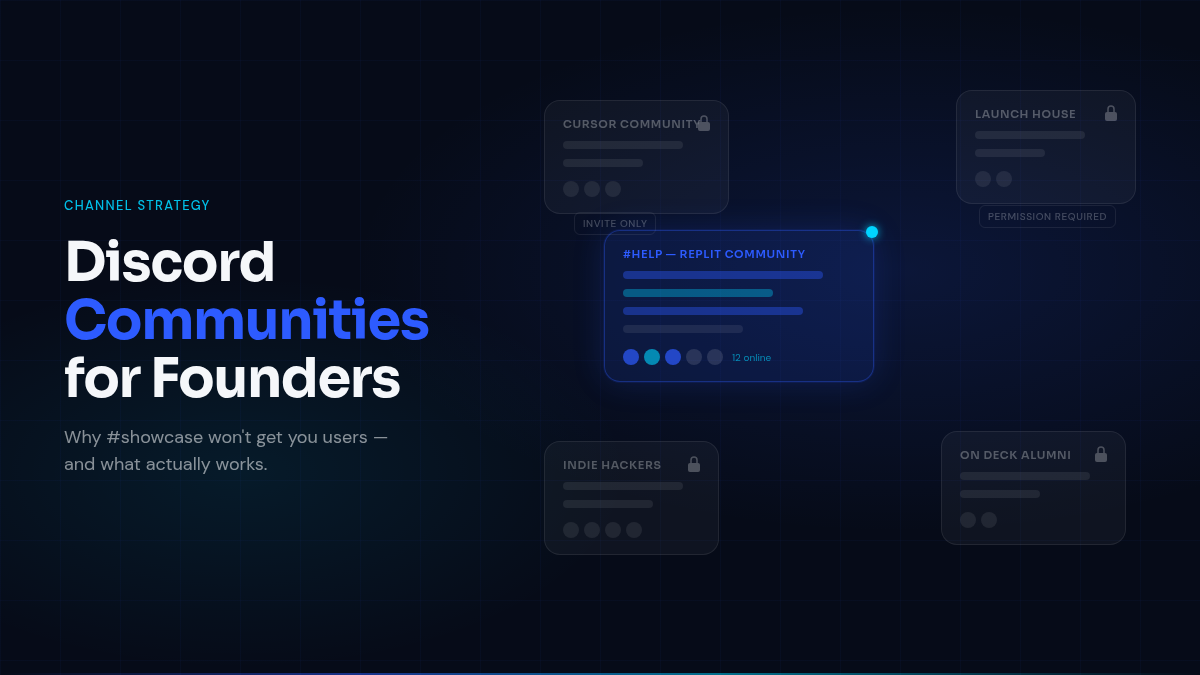
You joined the Cursor Discord. Posted in #showcase. Got two heart emojis, one generic “cool!” and one request to check out someone else’s project. You joined a founders Discord, introduced yourself with your product pitch, got a few welcomes that went nowhere. Three servers, four weeks, no users.
Discord keeps showing up on every distribution channel list. It belongs there. But most founders treat it like Reddit or Twitter — broadcast something and wait. That doesn’t work on Discord, and understanding why explains how to use it correctly.
Why Discord is structurally different
Reddit has a public search API. Twitter indexes every post. Product Hunt’s homepage is visible to anyone. These are all broadcast surfaces: post once, strangers discover it indefinitely.
Discord is the opposite. Servers are closed rooms. There’s no global search. If you’re not in the server, none of its content shows up in Google. Reputation is local: being helpful in one server means nothing in another. Every server has its own culture and its own hierarchy of regulars who’ve been there for months or years.
That’s why the standard distribution playbook breaks there. You can’t get anything from Discord through volume or timing. You earn trust server by server.
We built CrossMind to automate as much of the acquisition loop as possible. When we tried to build Discord as an automated channel, we hit the wall fast: Discord’s API requires a bot with explicit admin permissions from each server owner. No global search API, no public feed, no way to surface conversations at scale without violating terms of service. We tell founders this upfront during Onboarding: Discord is manual, period.
That’s not a knock on Discord. It just means it’s selective. Founders who work it properly get early adopters who stick around. The ones who try to shortcut it get ignored or quietly kicked.
The three types of Discord servers worth joining
Most Discord guides give you a server list. That’s the wrong frame. Which servers matter depends on who you’re targeting.
Builder tool communities. Cursor, Replit, Lovable, Claude, Bolt. These are where people who are actively shipping products hang out. If your ICP built with these tools and now needs users, this is where they are. Focus on #help, #showcase-feedback, and project channels where people share what they’re working on.
Founder and maker communities. Indie Hackers Discord, Launch House, On Deck alumni groups, the various build-in-public servers. Mixed in terms of stage, but full of people who understand the early-user problem because they’re in it. These tend to be more receptive to honest conversation about distribution than most other communities.
Your user’s identity communities. This is the one people miss. If your product solves a problem for content creators, find content creator Discords, not founder Discords. If it’s for e-commerce sellers, find seller communities. Your best early users are in communities organized around the problem you solve, not around the founder lifestyle.
How to find the right servers
Discord’s built-in discovery is terrible for this. It surfaces large gaming and hobby communities and not much else. Here’s what actually works:
Search Google for your niche. “{tool name} discord” or “{topic} discord” will surface the most popular servers for any niche. Cursor Discord, Replit Discord, most vibe-coding communities show up immediately. Google knows about them even when Discord’s own discovery doesn’t.
Start from the subreddit. Most active Reddit communities with a Discord link it in the sidebar or pinned posts. If you’ve already mapped the subreddits where your ICP hangs out, check whether they have a companion Discord. The audiences overlap heavily.
Twitter/X bios and threads. Founders who run communities drop their invite link in their bio or in announcement posts. Search “discord.gg” from accounts in your space.
Product Hunt comments. When something launches in your category, scan the comments. Community builders often post their Discord link there. It’s one of the more reliable places to find active, relevant servers.
How to participate without being ignored
Getting into the right servers is step one. Most founders who get nothing from Discord fail at step two.
Spend the first week just reading. Find out who the active regulars are. Identify the channels where people ask questions rather than post announcements. That’s where your time should go.
After that: answer questions first, share second, pitch never. Answer things in the channels where your domain is relevant. Share specific things you’ve learned recently, not product pitches. This takes about 15 minutes a day if you stay focused on one or two channels per server.
What not to do: lead with your product in your intro. Post in #showcase in the first two weeks. DM people who haven’t talked to you. Discord communities have long memories. Getting labeled as someone who only shows up to promote will follow you around in that server indefinitely.
DMs make sense after you’ve had at least two real public exchanges with someone. At that point, a brief message acknowledging the conversation and mentioning what you’re working on lands as natural. Earlier than that, it’s an ambush.
The actual timeline
Discord converts much slower than Reddit. A Reddit post can bring users within 24 hours. Discord participation builds over weeks.
Budget 4–6 weeks of daily presence — 15 minutes a day in the channels where your ICP actually asks questions — before expecting meaningful conversion. What you get after that isn’t traffic. It’s people who know you, have seen you be useful, and have already decided you’re worth paying attention to before they ever visit your product page.
We ran 69 cold DMs on Twitter with 0% reply rate, then moved to warm outreach: public engagement first, DMs only after real back-and-forth. Discord works the same way. You have to earn the conversation before you can have it.
For faster signal, Reddit converts quicker and the communities are easier to find. Use Discord for depth, Reddit for speed. The full channel map across platforms has the prioritization breakdown if you’re still figuring out where to focus.
What CrossMind actually does with Discord
We can’t automate Discord participation. No public search, no scalable bot access without per-server admin permissions, and community norms that would identify and remove any automated actor quickly.
What we do during Onboarding: the 30–40 minute research run maps your ICP’s top communities across platforms, including the specific Discord servers where your target user is most active. The output names the servers, explains why each one is relevant, and identifies which channels are worth your time.
The daily participation is still on you. What we cut is the research overhead: figuring out which servers even exist and which ones are worth the time commitment.
If you’re past the discovery question and ready to run the participation strategy, how to find beta users before launch covers the broader pre-launch loop. For platform prioritization, indie hackers vs. reddit vs. product hunt is the right starting point.
Discord is worth it if you’re willing to be patient and specific about which servers matter. Shortcuts don’t work here.
CrossMind maps where your ICP communities actually are, including the specific Discord servers and channels worth your time. Run the Onboarding research to see where your first users are.