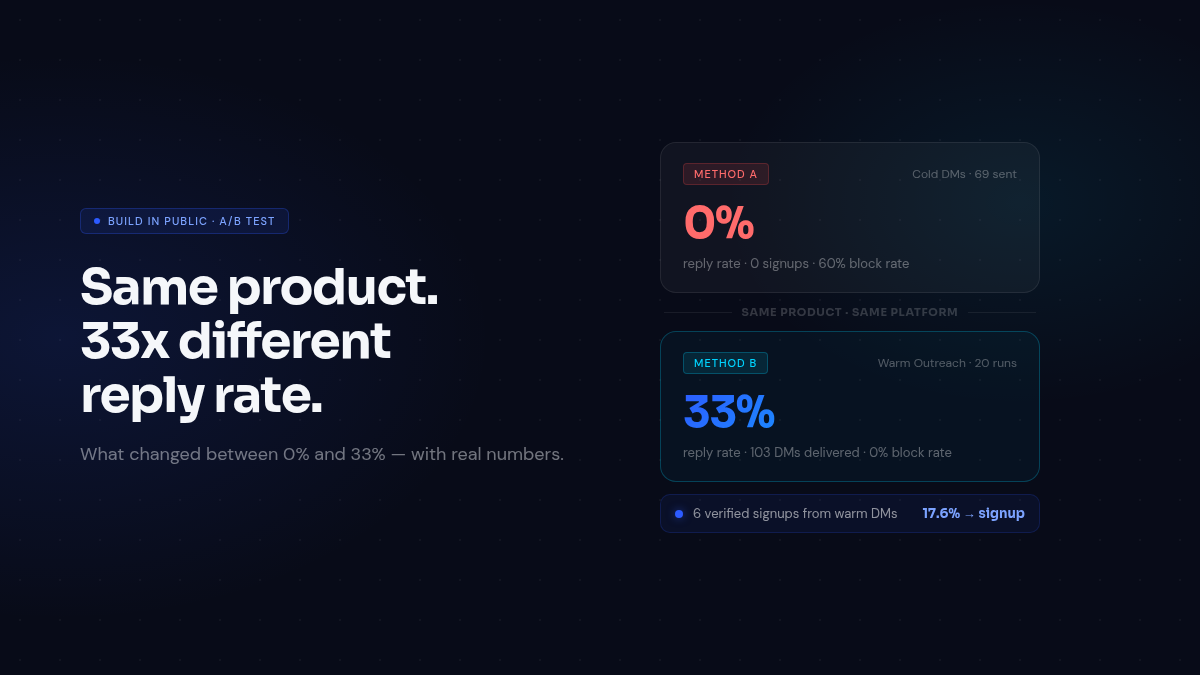
TL;DR: We ran 69 cold DMs and got zero replies. Then we changed the method, not the product, not the platform, not the target users, and got a 33% reply rate across 20 runs. Six of those conversations converted to signups, all verified in PostHog. Here’s what we changed and why it worked.
The setup
For about six weeks starting in February, we ran cold DMs as our primary outreach channel. The mechanics: identify founders on Twitter with 500+ followers who were building products, send a short message explaining what CrossMind does, follow up if no response.
69 messages. 40 days. Zero replies.
We wrote about the postmortem here. The short version: we were interrupting strangers who had no context for why we were reaching out.
After retiring cold DMs, we tried a different method. Same platform (Twitter). Same target users. Same product. Different approach entirely.
We called it the X Drop Pipeline.
What the X Drop Pipeline actually does
Twitter regularly surfaces threads where builders share what they’re working on. “Drop your product,” “what are you building,” “show me your side project” — these threads get hundreds of replies from founders explicitly saying “I have a product and I want people to see it.”
That’s a different signal than someone with a public profile that says “founder.” The thread reply is self-selection: they’re actively raising their hand, right now, saying “I built something and I’d love an audience.”
The pipeline works in four steps:
-
Public reply in the thread. Before any DM, we reply publicly to the founder’s product drop with something genuinely useful: an observation about their positioning, or a question about their distribution approach. Visible to everyone in the thread, not just them.
-
Follow. After the public reply, we follow the founder. This gets us the “followed you” notification that puts our name in their head a second time.
-
Wait for mutual follow. If they follow back, they noticed us twice: once in the thread, once in their notifications. At this point, DMs are open.
-
Context-first DM. The message references the conversation: “Saw your product in [thread], replied earlier. If finding your first users is something you’re working on, CrossMind might help. Happy to share what we’ve been doing.” Not a pitch. A continuation.
The numbers
| Cold DMs (Feb-Mar) | X Drop Pipeline (Apr) | |
|---|---|---|
| Runs | 67 | 20 |
| DMs delivered | 54 | 103 |
| Reply rate | 0% | ~33% |
| Block rate | ~60% | 0% (from Run 3 onward) |
| Verified signups | 0 | 6 |
| Delivery rate | ~40% | 84% |
The 6 verified signups: Yong (via b0ssY2), Victor (via victor36max_), Alex (via Alex95627675112), Swook (via lswoogie), Sadiq (via uixsadiq), and Amin (via amincodes). All cross-referenced in PostHog — the app link sent in the DM led to the signup event.
Why the 0% happened
Cold DM failure isn’t usually about message quality. It’s structural.
The recipients have no context for who you are. Their filter for “AI product I’ve never heard of reaching out” is basically 100% ignore. And on Twitter specifically, accounts with privacy settings blocking strangers from DMing them are common. Our 40% delivery rate tells you how many founders had simply turned off incoming DMs from non-followers. Of the messages that did land, the response was silence. No opt-out, no pushback, just nothing.
The 60% block rate on early cold DM runs is the clearest data point: we weren’t being evaluated. We were being flagged as spam.
Why 33% happened
The warm approach changed what we were asking for.
Cold DM: a stranger asking for your attention. X Drop: someone who already responded to what you shared, whose name you’ve now seen twice, asking if you want to continue a conversation.
The bar is completely different. By the time the DM arrives, there’s been a public exchange. They’ve seen our reply in the thread. They got the follow notification. If they followed back, they made a small voluntary investment in the connection. The DM isn’t an interruption at that point.
The block rate dropping to zero says it plainly. People don’t block follow-ups from conversations they chose to continue.
What this tells us about outreach more broadly
The 33x difference came from one variable: trust context before the ask.
Finding the active signal matters more than finding the right profile. A founder who publicly posts “drop your product” is signaling a need right now. A founder with 500 followers who looks like a good fit might not be thinking about distribution at all at this moment.
The public reply also establishes you as a real person in a real conversation before any private contact. You can replicate this pattern on Reddit (comment before DM), LinkedIn (comment before InMail), or anywhere with public threads. When the DM references an existing exchange, it’s a follow-up, not a cold open. Recipients process those differently.
What we’re doing now
The X Drop Pipeline runs automatically as part of CrossMind’s outreach execution. For each run, it finds active “drop your product” threads, identifies the highest-signal replies, engages publicly, and sequences the follow-up from there.
The 33% reply rate isn’t fixed. Early runs had higher block rates before we tightened the ICP filtering and added the mutual-follow gate. From run 3 onward, the numbers stabilized. The 6 signups represent a 17.6% conversion rate from app link sent to actual registration, which is higher than our landing page’s cold traffic conversion by a meaningful margin.
The method matters more than the channel. Twitter DMs produced both 0% and 33%. The difference wasn’t the platform. It was whether we’d earned the right to be in someone’s inbox before we tried to get there.
If you want CrossMind to run this same pipeline for your product — finding self-selecting founders in “drop your product” threads, engaging publicly first, then following up with context — Onboarding takes 40 minutes. You’ll see the target account list and outreach plan before you’re asked to pay.