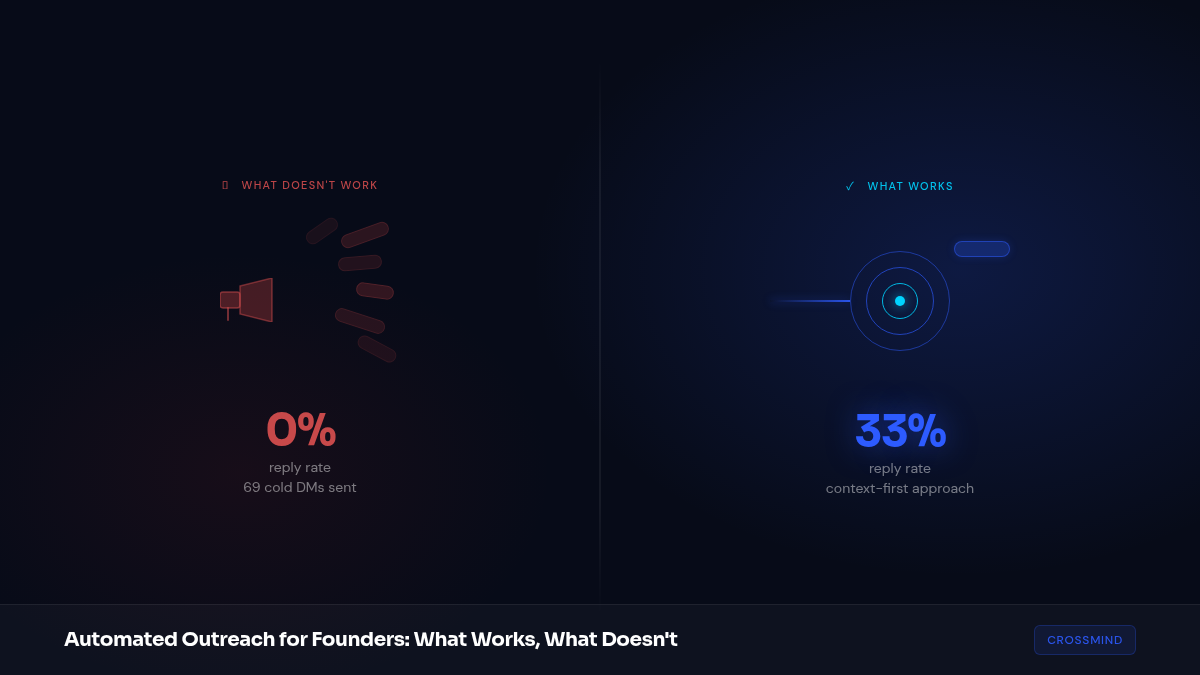
TL;DR: We ran 69 cold DMs, got zero replies. Then ran a different outreach method — context-first, trigger-based — and hit 33% reply rate with 6 verified signups. The difference wasn’t the platform or the product. It was the sequence.
Most founders, when they start thinking about automated outreach, imagine the same thing: a tool that sends messages at scale so they don’t have to. Find a list, write a template, send it to everyone, see what comes back.
That’s not outreach. That’s spam with extra steps.
The version that actually works looks almost nothing like that.
The prerequisite most founders skip
Before automating anything, answer two questions:
-
Can you name a specific behavioral signal that tells you this person is thinking about the problem you solve right now — not that they match a demographic, but that they did something that shows readiness?
-
Do you have any presence in the space they’re in? A comment they might have seen, a post they might have read?
- If yes to both: Automation can compress the timeline. The sequence below works.
- If no to either: Automation will accelerate rejection. No amount of message quality fixes the absence of signal and familiarity.
The failure mode that follows — 69 cold DMs, 0% reply rate — is what happens when the answer to both questions is no. We automated something that hadn’t earned the right to be sent yet.
Why automated outreach fails
The failure mode isn’t automation itself. Automation is just a delivery mechanism. The failure is in what’s being automated.
Founders trying outreach for the first time typically automate the worst possible version of what a human salesperson would do: reach out to a stranger with zero shared context and explain why that person should pay attention to them.
There are three specific failure points:
No prior signal. A cold DM from someone you’ve never heard of, offering a product you didn’t ask about, arrives with no context. The default reaction is mild suspicion. The second default is to ignore it.
Wrong targeting signal. “Founders on Twitter” is a demographic, not a behavior. A founder who just shipped a launch post is in a completely different headspace than one who’s been posting about AI infrastructure for a week. Demographic targeting misses this.
Single-touch sequences. One message, then silence. When the first message gets ignored, there’s no recovery path.
What the data showed
We ran cold DMs for six weeks. 69 messages sent. 40 days. Zero replies.
We wrote about that postmortem in Cold DM vs. Warm Outreach: What a Real A/B Test Told Us. The short version: 60% of recipients had DMs blocked by privacy settings, and the 40% who could theoretically receive a message showed zero engagement with an unsolicited pitch from someone they’d never seen.
That same stretch also revealed something structural: the signal we were using to pick targets (“has a founder-sounding bio and 500+ followers”) told us almost nothing about whether that person was currently thinking about distribution. We were sending the right message to the wrong moment.
What changed
After retiring cold DMs, we rebuilt around one principle: automate the sequence, not just the message.
The trigger that worked best: Twitter threads where builders drop their products. “What are you building?” threads. “Show me your side project” threads. These are self-selecting. People actively, publicly looking for attention right now. That’s a behavioral signal, not a demographic one.
The sequence:
Step 1: Public reply first. Before any DM, respond publicly in the thread where the founder posted. Say something useful (an observation about their positioning, a question about their go-to-market), not a pitch. Visible to everyone in the thread.
Step 2: Follow. After the public reply, follow them. They now have two signals: someone replied thoughtfully in their thread, then followed shortly after. Not random. Enough to register.
Step 3: Wait for mutual follow. If they follow back, the DM pathway is open and they’ve shown awareness of the account.
Step 4: Context-first DM. Reference the conversation: “Saw your product in [thread], replied earlier about your positioning. If finding your first users is something you’re working on, happy to share what we’ve been doing with CrossMind.” No pitch. No feature list. A continuation of something that already happened.
Results after 20 runs: 33% reply rate. 103 DMs delivered. Six converted to verified signups in PostHog.
The underlying principle
Outreach works when it catches someone at a moment of readiness, after they already know who you are, with a message that matches the conversation they’re already having.
Every element above serves that:
- Behavioral trigger (thread drop): catches readiness
- Public reply: establishes familiarity
- Mutual follow: confirms bidirectional awareness
- Context DM: matches the existing conversation
Skip any step and the reply rate drops. Public reply without follow: slightly familiar stranger. DM without public reply: cold again. Follow without context: just another follower.
The message matters less than the sequence. A mediocre DM that follows this structure will outperform a well-written cold one.
The same logic applies to other channels
Community forums (Reddit, IndieHackers): Find threads where your target users are asking questions your product answers. Comment with a useful answer before you mention the product. The comment history creates context; the follow-up lands in a familiar frame rather than out of nowhere.
Email sequences: If someone clicked through to your pricing page but didn’t sign up, their behavior is telling you something. A triggered email that references what they did (“you looked at the pricing page — what got in the way?”) will outperform a drip campaign that treats everyone identically.
LinkedIn: Comment publicly on posts in your target space before connecting. When the connection request arrives, the name is already familiar.
Discord and Slack: Post genuinely helpful messages before reaching out to individuals. Communities have long memories. A useful post from two weeks ago is still working for you when someone checks your profile.
The pattern is the same everywhere: establish presence publicly, find behavioral signals, reach out privately once familiarity exists.
| Channel | Behavioral trigger | Sequence | Expected range |
|---|---|---|---|
| X / Twitter | Founder posts in “drop your product” thread | Public reply → follow → wait for mutual follow → context DM | 25–35% reply rate |
| Reddit / IH | User asks a question your product directly answers | Useful comment → 2–3 days → mention product if directly relevant | Varies by community |
| Visited pricing page, didn’t convert | Single triggered email referencing that specific action | 10–25% reply rate | |
| Posted in your ICP’s topic area | Public comment → connection request with a note referencing your comment | 15–30% acceptance | |
| Discord / Slack | Active in a channel where your problem is discussed | Helpful public message → DM only after familiarity builds | Low — only with genuine fit |
What still doesn’t work
Volume first. Sending to 1,000 people a day still doesn’t work if the sequence skips familiarity-building. High volume just amplifies the failure rate.
Fake personalization. Scraping someone’s bio and writing “Hey Sarah, I noticed you’re building a productivity app” isn’t context. It’s personalization theater. Real context means referencing something they said, not something they are.
Targeting people who didn’t signal anything. Follower lists, LinkedIn scrapes, email databases are demographics without behavioral signals. Without a signal that someone is currently thinking about the problem you solve, reaching out is interruption.
Single-touch sequences. One message, then silence. This would work in a world where everyone checks DMs immediately and is already looking for exactly what you’re selling. That world doesn’t exist.
How CrossMind runs this
Our outreach runs through the sequence above. CrossMind handles the automation: finding threads, identifying self-selected builders, managing the reply/follow/DM timing. The judgment call (what to say and how to read what someone’s building) still requires a human in the loop.
The Onboarding research process maps where your ICP is actively having conversations, which channels they use, and which specific threads are live right now. That’s the starting point. The outreach sequence is what runs after.
Before setting up any outreach automation, audit the sequence against three gates:
| Check | Pass | Stop |
|---|---|---|
| Trigger | Behavioral signal (they did something) | Demographic filter (they are something) |
| Familiarity | They’ve seen you before | They’ve never encountered your name |
| Message | References something specific they said or did | Template that could go to anyone |
If all three are Pass: automate it and measure reply rate.
If any are Stop: fix that step before you scale. Volume amplifies failure — it doesn’t overcome it.
CrossMind runs this sequence autonomously. You tell us what you’re building; we map the communities, find the behavioral signals, and execute the outreach — including the public-reply-before-DM step that most founders skip because it requires manual coordination. See how it works →