TL;DR: There are now dozens of products calling themselves AI cofounders. Most help you plan, build, or document. Almost none do the thing that actually stalls early-stage companies: finding users. This gap isn’t obvious until you’ve been using the tools for a month and still have no signups.
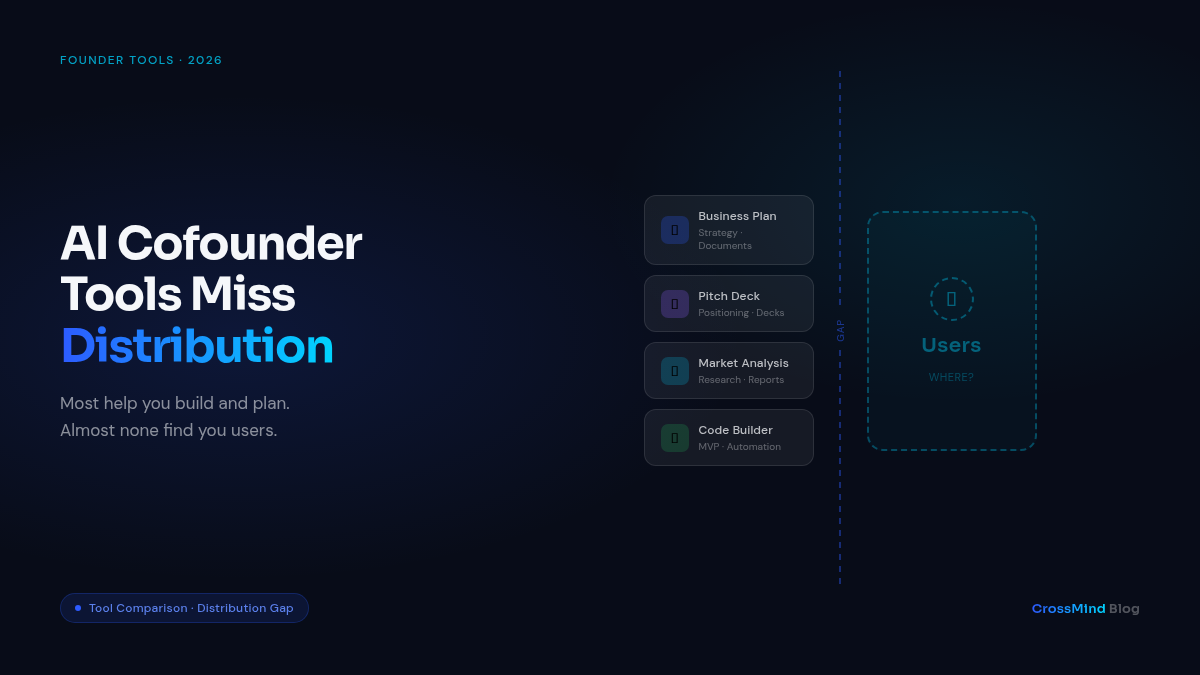
The “AI cofounder” category has exploded. One platform claims 80,000 founders. Another bundles pitch decks, business plans, and validated playbooks into a single subscription. A third offers to analyze your startup’s competitive landscape on demand.
Here’s a data point from our own experience: we had 20 real users after several months of effort. One came from our landing page. It turned out to be a disposable email address.
The landing page traffic wasn’t the problem. We had visitors. The problem was that passive channels, even good ones, don’t close the gap at early stage. Most AI cofounder tools are built for the wrong half of the problem.
How the category actually breaks down
Honest labeling first. Not all “AI cofounder tools” are trying to do the same thing.
Category 1: Build accelerators
Cursor, Claude, Replit, Bolt. These make building faster. They’re legitimate and useful. They’re also not cofounders. No one asks “should I use Cursor or hire a cofounder?” They solve a different problem.
Category 2: Strategy and planning tools
Business plan generators, market analysis tools, pitch deck assistants. These help you think through positioning and document it. Cofounder AI, various “business model canvas” tools, some sections of platforms like ChatGPT fall here.
They’re useful for clarity. But strategy documents don’t acquire users. A 40-page market analysis doesn’t get you your first 10 signups.
Category 3: Productivity and admin automation
Meeting summaries, email drafting, task management with AI overlays. Real time saved. Still not the category that closes the distribution gap.
Category 4: Execution on user acquisition
This is the category where early-stage startups are actually stuck. Not stuck on building. Not stuck on having a plan. Stuck on getting real people to find, try, and pay for the product.
This category is almost empty.
Why the distribution gap is where companies actually fail
Jake came to us after 10 failed startups. His pattern was consistent: he could build, he could plan, he had solid ideas. The wall he kept hitting was what he called the “marketing barrier,” not knowing how to find people who’d actually care about what he was building.
Jake isn’t unusual. He’s the median early-stage founder.
The distribution problem isn’t new. What’s new is that AI has compressed the build timeline so dramatically that founders hit the distribution wall faster. You used to have months to figure out growth while still building. Now you have weeks.
Most AI cofounder tools made building faster. Almost none of them made distribution easier.
What distribution execution actually requires
The tools that could close this gap would need to do a few specific things.
Research, not just advise. There’s a difference between “try Reddit” and showing you 20 specific Reddit threads from the last week where your ICP is asking questions. The first is advice. The second is research. Research is harder to automate because it requires understanding your product deeply enough to know what matches.
Our onboarding research runs 30-40 minutes and produces 20 specific Reddit threads, 15 target Twitter accounts, a community map across 5 platforms, and a first-week execution plan. It doesn’t produce a memo suggesting you “consider community-based marketing.”
Finding users where they are, not where they’re easy to reach. Cold outreach is easy to automate. It’s also ineffective. We ran 69 automated cold DMs to founders who were publicly discussing growth problems. Zero replies. Not low. Zero. The outreach was reaching people, but cold messages get filtered before they’re read.
What works instead: find conversations already happening, contribute something real, then reach out to people who’ve already had a positive interaction with you. Across 20 runs of this approach: 103 DMs delivered, 33% reply rate, 6 verified signups tracked from DM to registration.
Memory across runs. One-shot research doesn’t compound. A tool that scans Reddit once and gives you a list is useful. A tool that scans twice a week, recognizes which communities are producing engagement, and adjusts its priorities accordingly is a different product.
The user attribution reality
We ran a full attribution analysis across our first 20 real users. Here’s the breakdown:
| Source | Users | Share |
|---|---|---|
| X Drop Pipeline (automated warm outreach) | 7 | 35% |
| Direct referrals from Ivan | 6 | 30% |
| Prospect outreach | 3 | 15% |
| 1 | 5% | |
| Landing page | 1 | 5% |
| Other direct | 2 | 10% |
The landing page, with months of content and reasonable traffic, produced one user who used a disposable email address and showed zero activity.
Every channel that worked involved some form of personal, contextual contact. X Drop is built around this: public reply in a relevant thread, follow, wait for a mutual follow, contextual DM. Each step is trackable. Passive traffic isn’t.
This isn’t an argument against content or landing pages. It’s an argument against using them as your primary early-stage acquisition channel, and against expecting any AI tool to fix that by producing better copy.
Three questions before committing to any “AI cofounder” tool
1. What does it do when you’re not using it?
If the answer is nothing, it’s a capable assistant. Control flow is what separates a cofounder from a chatbot. A real cofounder works on their domain whether or not you’re prompting them.
2. Does it execute on user acquisition, or advise on it?
Advice is easy to generate. Execution requires platform access, scheduling, context about your specific product, and multi-step sequencing that runs without you triggering it. Ask what the tool’s last output was to an actual user. If it was a strategy document, that’s what it does.
3. Does its model of success match yours?
“Helps you think through your GTM strategy” is a success metric for a planning tool. “Produced three signups this month” is a success metric for a cofounder. These are different things, and conflating them leads to a month of nothing happening while you feel like you’re working.
The AI cofounder category will keep growing. The tools will get better. The distribution gap will stay until someone specifically builds for it, because it’s harder, requires deep product context, and doesn’t produce clean demos.
If you’re in the post-launch, no-users phase, the first question worth asking any tool is: does it find users, or does it help you think about finding users? That one difference tells you which half of the problem you’re actually paying for.