TL;DR: Most AI cofounder comparison posts rank tools by features, pricing, and integrations. None of that matters if the tool doesn’t help you solve the problem that actually kills early-stage companies: finding users. Here’s a comparison framework built on real outcome data, 20 users, full attribution, zero guesswork.
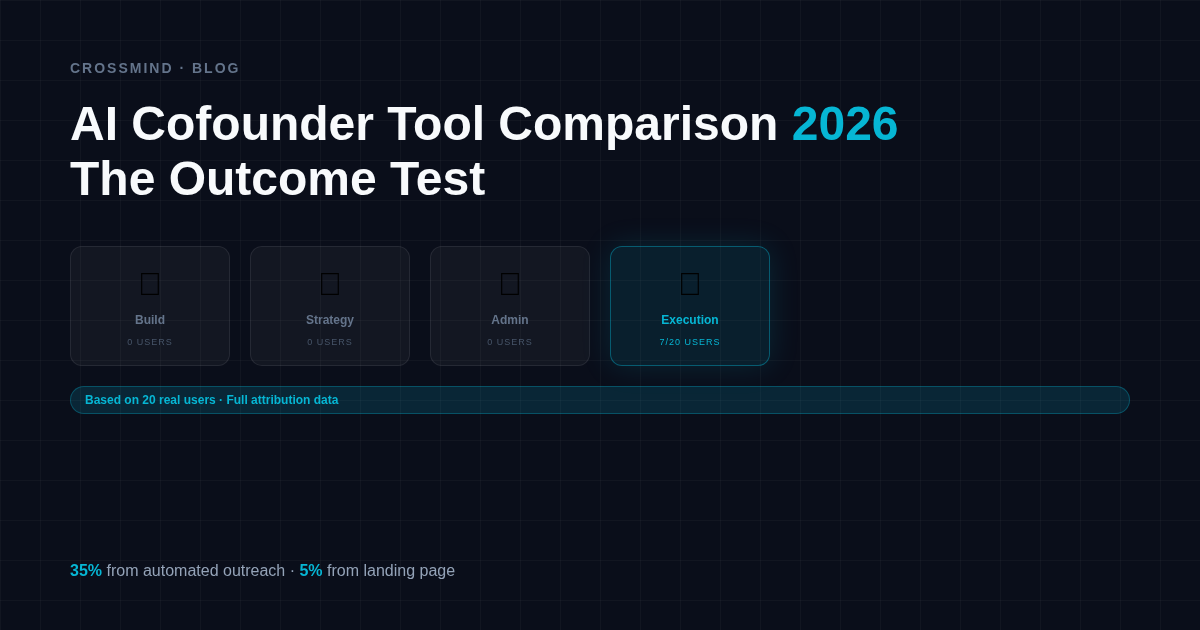
Why most AI cofounder comparisons are useless
Search “best AI cofounder 2026” and you’ll find the same format repeated everywhere. A table with five to ten tools. Columns for features, pricing, ease of use, integrations. A winner declared at the bottom, usually the one with the longest feature list or the affiliate link.
What those comparisons don’t tell you: whether the tool will help you get a single user.
We know because we read them. Tried tools based on those recommendations. After months of using various “AI cofounder” products, we had 20 real users. The attribution data from those 20 users revealed something no feature comparison captures.
One user came from our landing page. Disposable email address, zero activity.
Seven came from an automated warm-outreach pipeline we built ourselves. Six came from personal referrals. Three came from targeted prospect outreach.
The tools we’d been comparing on features and pricing had contributed nothing measurable to user acquisition. Not because they were bad tools. Because they solved a different problem than the one we actually had.
The outcome test
Instead of comparing features, compare tools against the bottleneck you’re actually facing. For most founders reading “best AI cofounder” lists, that bottleneck isn’t building, planning, or automating admin tasks. It’s distribution.
The test: does this tool help you acquire users, or does it help you do something else while your user count stays flat?
Here’s how the major AI cofounder categories perform against that test, using our own data.
Category 1: Build accelerators
Tools: Cursor, Claude, Replit, Bolt, Windsurf, v0
These are the tools that compress your build timeline from months to weeks. Genuinely excellent. If you’re using one, you’re probably shipping faster than you would have a year ago.
What they do well: Code generation, debugging, rapid prototyping, UI scaffolding. Cursor’s codebase-aware completions and Claude’s reasoning depth are real productivity multipliers.
What they don’t do: Find users. A faster build process doesn’t create demand. You’ll ship sooner, but you’ll hit the same distribution wall, just sooner.
Outcome test result: 0 of our 20 users came from any build accelerator. These tools made our product better. They didn’t make it found.
Verdict: Use them. They’re not optional in 2026. But don’t call them cofounders, and don’t expect them to solve your acquisition problem.
Category 2: Strategy and planning tools
Tools: Cofounder AI, various business-plan generators, market analysis platforms, ChatGPT when used for strategic Q&A
These tools help you think. They generate pitch decks, business model canvases, competitive analyses, and GTM frameworks. Some are genuinely thoughtful. Cofounder AI’s validated playbook approach is more structured than a blank ChatGPT window.
What they do well: Structuring your thinking, producing documents, surfacing frameworks you might not know exist.
What they don’t do: Execute. A 40-page market analysis doesn’t acquire a single user. A pitch deck doesn’t either. The gap between “I have a strategy document” and “I have 10 signups” is where most founders stall.
Outcome test result: 0 of our 20 users came from any strategy artifact. Our ICP definition went through three rewrites based on real user behavior, not strategy documents. Each rewrite was informed by what users did, not what a planning tool predicted.
Verdict: Useful for clarity early on. But strategy tools create an illusion of progress. You feel like you’re working on your startup when you’re really organizing your thoughts. Set a hard time limit. A few days, not a few weeks.
Category 3: Productivity and admin automation
Tools: Zapier, n8n, Make, various AI-powered task managers and meeting summarizers
These tools save time. Automate repetitive work. Legitimate infrastructure.
What they do well: Connecting systems, automating workflows, reducing manual overhead.
What they don’t do: The work that actually produces users. Zapier can post your blog to Twitter automatically. But automated posting isn’t user acquisition. It’s distribution of content you already made. If the content doesn’t resonate, the automation just distributes nothing faster.
Outcome test result: 0 of our 20 users came from any automation pipeline. Zapier workflows ran for months on our side. They moved data between tools. They didn’t move users into our product.
Verdict: Use them for internal operations once you have something to automate. Don’t confuse “my workflows are automated” with “my startup is growing.”
Category 4: User acquisition execution
Tools: CrossMind (us), and… not many others.
This is the category that actually produced users for us. Also the smallest category, because execution on user acquisition is genuinely hard to build.
What it requires:
- Deep product understanding, enough to know which Reddit threads, Twitter conversations, and community discussions match your ICP
- Platform access: authenticated accounts on Reddit, X, LinkedIn, IndieHackers
- Multi-step sequencing, not a single cold DM but a pipeline: public reply, follow, mutual follow, contextual message
- Memory across runs: recognizing patterns, adjusting strategy based on what’s working
What our execution looked like:
We ran 69 cold DMs to founders. Zero replies. The tool was working; the approach was wrong. Cold messages from strangers get filtered before they’re read.
So we rebuilt around “drop your product” threads on X — public conversations where builders self-identify as people who want their products seen. The new method produced 33% reply rates and 7 verified signups.
Outcome test result: 7 of our 20 users (35%) came from this pipeline. Another 6 came from personal referrals (30%), which also required contextual, personal contact, just done manually. Three more came from targeted prospect outreach.
Verdict: This is the category that actually moved our user count. If your bottleneck is distribution, this is where your time and money should go.
The comparison table most posts give you (and why it’s the wrong frame)
Here’s what a typical comparison looks like:
| Tool | Type | Price | Key Feature |
|---|---|---|---|
| Cursor | Build | $20/mo | Codebase-aware AI |
| Cofounder AI | Strategy | $29/mo | Validated playbooks |
| Zapier | Automation | $20/mo | 5,000+ integrations |
| CrossMind | Execution | From $15/mo | Autonomous user acquisition |
This table is technically accurate and functionally useless. It tells you what each tool does but not whether any of them will help you get users.
The question isn’t “which tool has the best features.” It’s “which tool addresses my actual bottleneck.”
How to actually decide
Run this diagnostic on yourself before comparing any tools.
Question 1: Can you build the product?
If no, use Category 1 (Cursor, Claude, Replit). Stop reading comparison posts and go build.
Question 2: Do you know who your users are and where to find them?
If no, spend a few days, not weeks, with Category 2 tools. Then validate against real behavior, not strategy documents. Our ICP got rewritten three times in six weeks based on user data. No planning tool would have gotten us there faster.
Question 3: Do you have users?
If you’ve launched and have fewer than 50 real users, your problem is Category 4. You don’t need a better build tool or a more sophisticated strategy doc. You need execution on distribution.
This is the diagnostic most founders skip. They keep adding tools from Categories 1–3 because those tools are easier to evaluate, easier to buy, and easier to feel productive while using. Meanwhile the user count doesn’t move.
What “best AI cofounder 2026” actually means
The label “AI cofounder” has become marketing noise. Every tool that uses an LLM calls itself a cofounder now. That dilutes the term until it means nothing.
A real cofounder does two things: takes ownership of a domain, and executes on it whether or not you’re watching. That’s what separates a cofounder from a chatbot.
If you’re comparing AI cofounder tools, the single most important criterion isn’t features or pricing. It’s: when you stop using the tool for a week, does anything happen?
If the answer is no, you have an assistant. A useful one, maybe. But not a cofounder.
The honest bottom line
We’re CrossMind, and we’re in Category 4. Not going to pretend we’re neutral. But the data above isn’t spun: 0 users from build tools, 0 from strategy tools, 0 from automation tools, 7 from execution. That’s our real attribution.
If your product is built and your bottleneck is users, that’s what we do. Tell us your product URL, and we’ll run a 30-minute research pass that produces specific Reddit threads, target accounts, and a first-week execution plan. Then we execute on it autonomously.
If your product isn’t built yet, go use Cursor. If you don’t know your ICP, use a strategy tool for a few days. If your admin work is drowning you, use Zapier.
Then come back when you need users.
Comparing AI cofounder tools? The only metric that matters at early stage is whether the tool helps you acquire users. Everything else is a feature list.