TL;DR: Automation tools (Zapier, n8n, Make) execute tasks you’ve already defined. AI agents handle tasks where the approach is still unknown. Most early-stage founders need both, for different jobs. The mistake is using one where the other belongs.
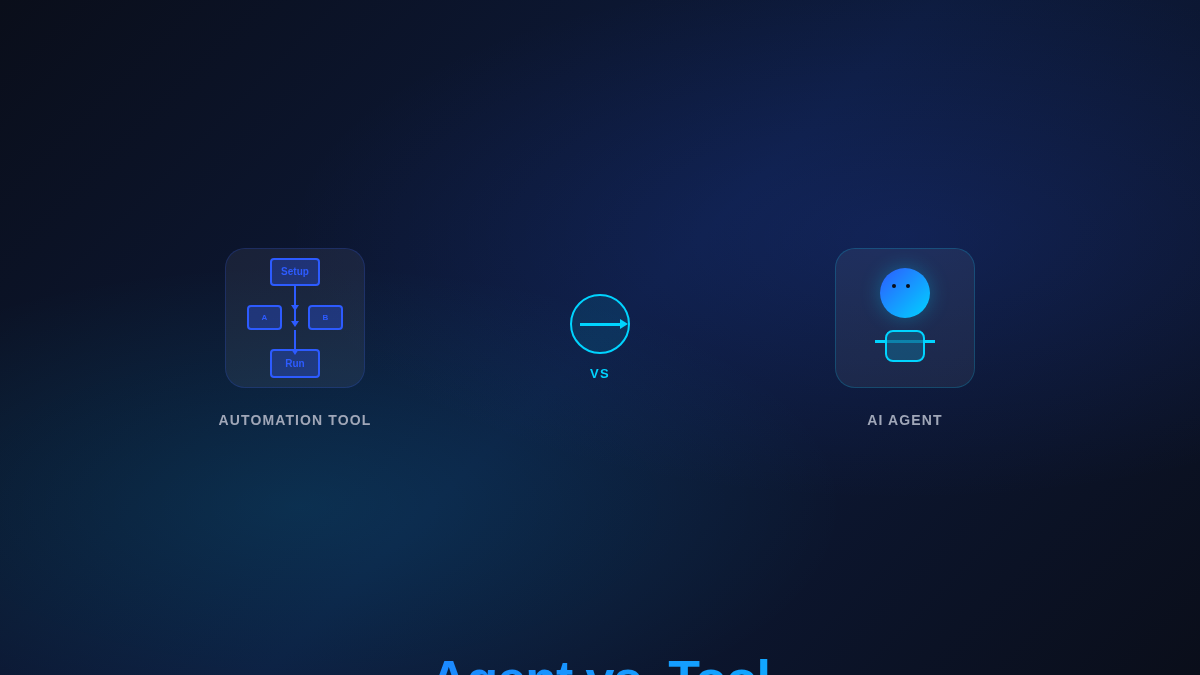
Every week, a founder in some indie hacker forum asks which tool they should be using: Zapier, n8n, Make, an AI agent, a custom script, or nothing. The answers are all over the place because people are solving different problems and calling them the same thing.
Here’s the actual distinction, and a decision framework that should save you a few wasted weeks.
The core difference: defined work vs. undefined work
Automation tools are designed for work where the process is already figured out. You know what triggers what. You know what the inputs and outputs look like. You just don’t want to do it manually every time.
Someone fills out your waitlist form → add them to your email list → send a welcome sequence → notify your Slack. That’s a workflow. Every step is predictable. Zapier is excellent at this.
AI agents are designed for work where the process isn’t defined. You have a goal but not a specific path. The agent has to decide what to look at, what matters, what to do next — and adapt based on what it finds.
“Find out which Reddit communities have the highest density of my target users, identify the threads worth engaging in, and surface the three most relevant conversations this week” is not a workflow. The right answer changes every week. You can’t pre-define the steps because the relevant information doesn’t exist until you go look.
What automation tools are genuinely good at
This isn’t a post arguing that you shouldn’t use Zapier. Zapier is the right tool for a lot of founder work:
- Any multi-step notification that follows a predictable trigger (form submission → CRM → Slack)
- Syncing data between platforms you already use (Airtable → Google Sheets, Stripe → HubSpot)
- Scheduled batch operations on structured data (weekly export, daily report generation)
- Connecting tools that don’t have native integrations
If you find yourself doing the same five clicks every time something predictable happens, Zapier is the right answer. The setup cost is low, the reliability is high, and the logic stays where you can see it.
n8n is worth knowing about if you want the same capability self-hosted, with more control over complex conditional logic and without per-task pricing at scale.
Where automation tools break down for early-stage founders
The problem isn’t that Zapier is bad. It’s that early-stage distribution work is mostly not the kind of work that can be pre-defined.
You don’t know which channel will work. You don’t know what messaging will resonate. You don’t know which communities have your users. You’re running experiments, not executing a known process.
Setting up Zapier workflows at this stage often feels productive while producing no user growth. We ran into this ourselves — we had clean automations for CRM updates, email sequences, and data syncing before we’d found a single acquisition channel that converted. The plumbing was excellent. The house was empty.
The actual bottleneck at early stage is usually channel discovery, not workflow efficiency.
What AI agents are actually suited for
AI agents are worth using when the work requires judgment that changes based on context.
Research and discovery is the clearest case: scanning communities for intent signals, evaluating which conversations are worth entering, identifying which content angles are getting traction. The agent reads things, forms conclusions, and surfaces what matters. You can’t pre-define this because it depends on what’s actually happening.
Strategy adaptation is another. When you’ve tried a channel and want to understand why it worked or didn’t, an agent can look at what you’ve run, compare it to what performed elsewhere, and suggest a different approach. That’s not a workflow — it’s analysis.
Then there’s work that requires understanding context: writing a reply to a specific thread, drafting outreach that references someone’s actual situation, summarizing what a community cares about this week. The output changes based on input that doesn’t exist until run time.
The failure mode for AI agents is treating them like smarter automation — giving them a rigidly defined task and expecting consistent output. They’re expensive and slow compared to Zapier for that use case. The value is in tasks that require genuine interpretation.
The actual decision framework
For any founder task, ask: “Could I write a deterministic flowchart for this?”
If yes: Zapier, n8n, or a cron script. Predictable input → predictable output → don’t overthink it.
If no: you either need an AI agent, or you need to do it manually until you understand it well enough to define the process. Automating before you understand the work usually just produces bad output faster.
A third option worth naming: do nothing. A surprising number of early-stage founder workflows aren’t actually worth automating. If you’re doing a task manually once a week and it takes five minutes, the setup cost of automating it is rarely worth it.
Where CrossMind fits
CrossMind is an AI agent, not an automation tool. The work we do for founders (mapping where their users are, identifying which communities to engage with, running research on what’s working in their space) changes every run based on what we find.
We did try to build this as a set of automation workflows early on. The problem was that the “right” research path for a productivity tool founder is completely different from the right path for a developer tools founder, and both change week to week. A rigid workflow produced generic output. The agent approach produces specific, actionable leads.
For the record, we also use Zapier internally. New user registration triggers a CRM update and a Slack notification. That’s a workflow. The strategic work is what the agent does.
The practical starting point
If you’re trying to figure out which category your problem falls into:
- Can you write out every step in advance, with clear inputs and outputs at each step? → Automation tool.
- Does the right answer depend on what you discover partway through? → AI agent or manual.
- Is this worth automating at all? → If it’s manual and takes under 10 minutes per week, probably not yet.
The founders who get the most out of AI agents are the ones who are specific about what they want the agent to figure out — not just “do my marketing” but “find where my users are complaining about the problem I solve, and surface the ten most relevant conversations from the last week.” Specificity about the goal, flexibility about the path.
If you’re still choosing which channels to prioritize before any of this, start here.
CrossMind handles the research-and-discovery layer that doesn’t fit in a workflow — finding your user communities, mapping intent signals, and identifying what to act on. If you want to see what that looks like for your specific product, start with Onboarding.