People keep asking what an “AI cofounder” does. The marketing answer is “it handles growth for you.” The honest answer is more specific and less glamorous: it runs tasks. Lots of them. Every day. Without you asking.
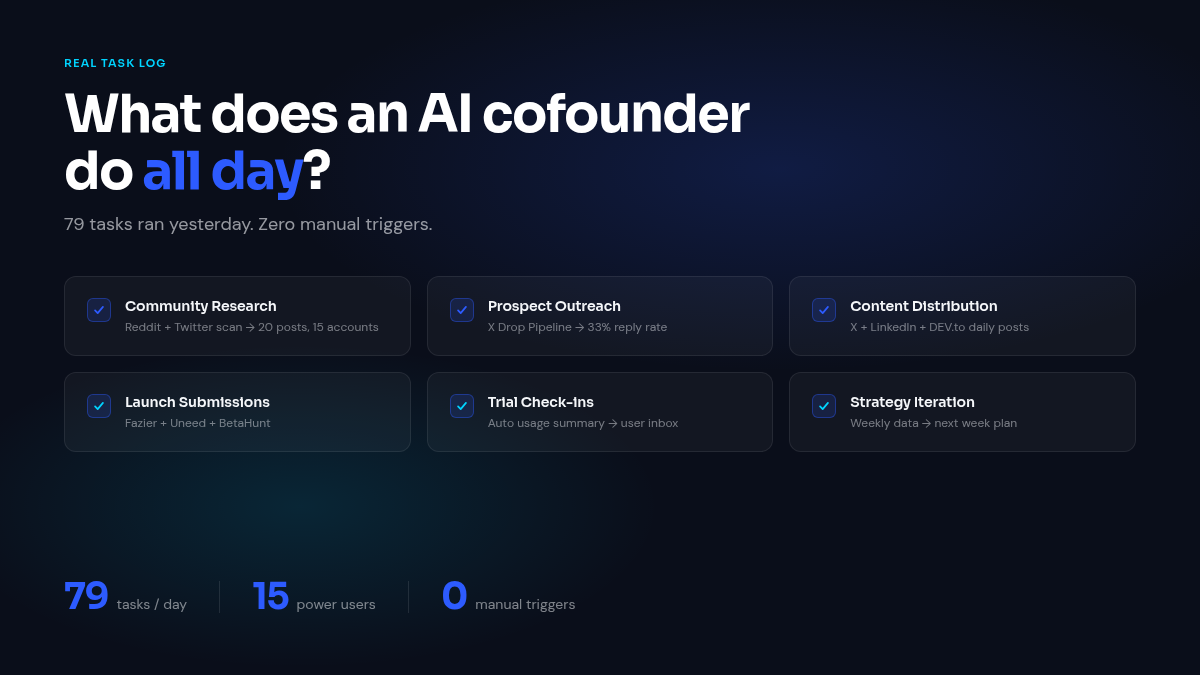
Our AI cofounder ran 79 tasks in a single day last week. Not because someone triggered them manually. Because 15 power users have active agents with scheduled work, and those agents just keep going.
Here’s what those tasks actually are — not the pitch, the real work log.
The six categories of work
When we started, we thought the agent would mostly do outreach. That was wrong. Outreach is maybe 20% of what it does. The rest falls into categories we didn’t plan for:
1. Community research (daily)
The agent scans Reddit, Twitter, and Indie Hackers for signals matching each user’s ICP. Not “post in r/startups.” It reads threads, scores relevance, and surfaces specific conversations where the user’s target audience is actively discussing problems.
One user’s agent found 20 relevant Reddit posts and 15 Twitter accounts in a 38-minute research run. That output becomes the input for everything else.
2. Prospect outreach (scheduled)
This is the X Drop Pipeline. The agent finds “drop your product” threads on Twitter, posts a public reply, follows the founder, waits for a mutual follow, then sends a contextual DM. Not a cold pitch — a follow-up to a conversation that already started.
Across 20 runs: 103 DMs delivered, 33% reply rate, 6 verified signups. The method matters more than the volume. We proved this the hard way: 69 cold DMs before this got zero replies.
3. Content distribution (daily)
Twitter posts, LinkedIn posts, DEV.to cross-posts. The agent writes them, schedules them, and tracks performance. When a topic gets engagement, it adjusts. When it doesn’t, it drops it.
This isn’t viral content. It’s consistent presence. The kind of thing founders know they should do but never have time for.
4. Launch directory submissions (on trigger)
When a user is ready to launch, the agent handles submissions to Fazier, Uneed, BetaHunt, and BetaList. It writes the copy, formats the assets, and submits. One user got 65 upvotes and 24 comments on Fazier without writing a single word of the listing themselves.
5. Trial user check-ins (automated)
After someone signs up, the agent monitors their activity. If they’re stuck, it sends a nudge. If they’re active, it sends a summary of what it did that day and what it recommends next. The user doesn’t have to ask. The agent just reports.
One power user has 13 runs across multiple tasks. They never asked for a status update. The agent sent them one after every run.
6. Strategy iteration (weekly)
Every week, the agent reviews what worked and what didn’t. Which channels produced signups. Which content got engagement. Which outreach messages got replies. Then it adjusts the next week’s plan.
This is the loop most founders skip because it requires pulling data from four different tools and making sense of it. The agent does it automatically.
What a Tuesday looks like
Here’s an actual day of task runs for one user’s agent:
| Time | Task | Output |
|---|---|---|
| 06:00 | Community research scan | 12 new Reddit threads, 8 Twitter accounts flagged |
| 09:00 | X Drop Pipeline run | 5 public replies posted, 3 follows sent |
| 12:00 | Content distribution | 1 Twitter post, 1 LinkedIn post scheduled |
| 15:00 | Trial user check-in | Usage summary sent to user |
| 18:00 | Prospect follow-up | 2 DMs sent to mutuals from morning replies |
Five tasks. Zero manual triggers. The user reviewed the morning research output and approved two of the Reddit threads for outreach. Everything else ran on its own.
What it doesn’t do
An AI cofounder is not a chatbot you ask questions. It’s not a workflow builder where you connect nodes.
It handles the execution layer — the work that needs to happen every day but doesn’t require founder judgment. Product decisions, pricing, deal-closing on calls: still yours.
The judgment calls are still yours. The agent just makes sure the work underneath them actually gets done.
The renewal signal
Six weeks in, one user renewed at full price. $99, up from the $49.50 first-month discount. They didn’t get a sales call. They didn’t get a nurture sequence. Their agent just kept running tasks, and the value was obvious enough that they paid again.
That’s the real test of an AI cofounder. Not whether it can write a viral thread. Whether it does enough useful work every day that paying for it feels like a no-brainer.
If you want to see what the agent would map for your product, the Onboarding runs the same research — 30 to 40 minutes, you see the output before you pay anything.
Related: How We Used an AI Agent to Run Our Entire User Acquisition | AI Agent vs. Automation Tool: What You Actually Need | Cold DM vs. Warm Outreach: What a Real A/B Test Told Us