TL;DR: Vibe coding compressed the time between idea and shipped product from months to days. That’s genuinely good. But it also created a new failure mode: founders who hit the distribution wall faster than any previous generation, with less time to mentally prepare for it.
You built something in a week. Maybe two. The product works. You showed it to a few people, they said “this is cool,” and you launched it. Then silence.
No signups. A handful of curious clicks that didn’t convert. The occasional pageview from a search engine that clearly wasn’t your target user.
This is the vibe coding no-users problem, and it’s different from the traditional post-launch silence in one way that matters: it happens faster, which means it hits harder.
Why vibe coders hit the wall faster
Before AI coding tools, building a product took months. That time served a hidden function: it forced founders to think about who would use the thing. You’d tell people you were building it. You’d talk to potential users during development. You’d iterate based on feedback that arrived slowly enough to absorb.
Vibe coding compressed that timeline to days. You can go from idea to deployed product before you’ve talked to a single potential user. The build phase that used to include early user discovery now happens so fast you skip it.
The result is a working product with no user pipeline, not because the product is bad but because the distribution work was never started.
This isn’t a criticism of vibe coding. It’s an observation about what the speed creates. The compression is real and valuable. Distribution just doesn’t compress the same way.
The mistake that looks obvious in retrospect
Most vibe coders with no users make the same diagnostic error: they assume the product is the problem.
“Maybe the landing page copy is wrong.” “Maybe the UX isn’t clear enough.” “Maybe I need to add more features before people will care.”
These might be real problems, but they’re second-order problems. You can’t optimize a conversion funnel with no traffic. You can’t learn from user behavior when there are no users.
The actual first-order problem, almost always, is that no one knows the product exists in the right way.
“The right way” matters here. Posting on Twitter that you launched and getting three likes from friends is awareness for people who already know you. That’s not distribution. Submitting to Product Hunt and getting buried on day two isn’t either, usually. Real distribution means finding specific humans who have your specific problem and reaching them at the moment they’re experiencing it.
That’s a research and contact problem. AI can help with pieces of it. But it can’t be vibe coded.
What the data actually shows
CrossMind’s target user is the vibe coder with no users: someone 4-12 weeks post-launch with fewer than 50 real users, who’s already tried at least one distribution channel and gotten little back.
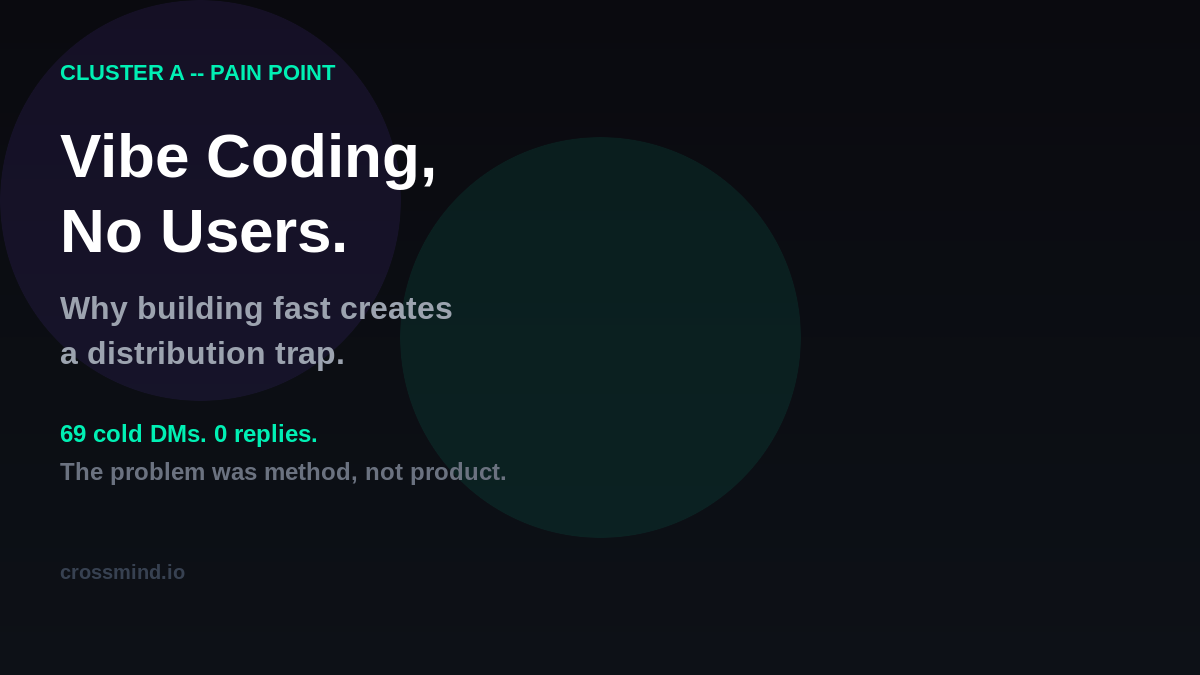
In our own early acquisition work, we sent 69 cold DMs to founders who fit our profile. Zero replies. Not one. This wasn’t because our message was bad or our product was weak. Cold outreach at zero credibility is functionally invisible.
When we switched to finding builders who had self-identified in public forums, people posting their products in “what are you building” threads and asking for feedback in launch communities, our reply rate went from 0% to 33%. Same product. Same channel. Different method.
The difference was self-identification. We stopped guessing who might have the problem and started talking to people who had explicitly said they had it.
That switch isn’t something you can write an AI prompt for and run automatically. It requires a clear answer to: where do your specific users gather and announce themselves?
Where to actually start
Find the self-identifiers first. Your future users are somewhere right now saying, explicitly or implicitly, “I have this problem.” On Reddit, this looks like threads about the frustration your product solves. On Twitter/X, it looks like people asking for tool recommendations or complaining about a workflow they can’t fix. On Indie Hackers, it’s milestone posts from someone who just shipped something and is asking what to do next.
The work is finding those people, not broadcasting at a general audience. The volume is lower. The conversion rate is not.
Make contact before you sell. The reply rate on cold outreach is low not just because the message is wrong. It’s low because it arrives without context. There’s no shared history, no warm signal, no reason for the recipient to believe this is anything other than a mass message.
Before you pitch, exist in the same space. Comment on their post. Reply to their question. Give useful information for free. When you reach out after that, you’re not a stranger. This takes more time per person than cold DM automation, and it’s also the only thing that actually works at the first-10-users stage.
Research before you pick a channel. Most vibe coders launch on Product Hunt because everyone says to launch on Product Hunt. Or they post in three subreddits because they’ve heard Reddit converts. But which specific subreddits? Which type of Product Hunt post, on which day of the week?
The channel choice matters less than understanding where your specific users actually are. That requires scanning communities, identifying where the conversations that match your problem space actually happen, and figuring out which ones are worth your attention. This research takes a few hours. Most founders skip it and pick channels based on what they’ve read works “in general.”
Distribution isn’t a phase you enter after the product is done
This is the trap vibe coding creates: because the build phase is so compressed, distribution feels like something you do “after,” a separate mode you shift into once the product is shipped.
It isn’t. Distribution starts with understanding who you’re building for well enough that you know where to find them. That understanding needs to exist before you ship, or immediately after, not as a vague post-launch todo.
The founders who get their first 10 users quickly aren’t better at marketing. They started the distribution work earlier, often before the product was finished, and they did it specifically rather than generally.
If you’ve been running for four weeks with no meaningful traction, the question isn’t what’s wrong with the product. The question is: where is the specific person who has my specific problem right now, and what are they saying about it?
If you can answer that with a real list of places and conversations, you have a distribution start. If you can’t answer it yet, that’s the actual blocker, not the feature set or the landing page copy.
What CrossMind does with this
The community research phase of CrossMind’s onboarding runs this analysis automatically. Given a product URL and a short description, the agent maps two axes: where builders like the founder gather, and where people experiencing the target problem gather.
The output is specific: named subreddits, Twitter accounts, Indie Hackers threads, launch communities, each matched to how closely it fits your ICP. It’s a starting point for the contact work, not a replacement for it.
The research phase takes around 30-40 minutes. That’s not the hard part. The hard part is that most vibe coders haven’t asked the question clearly enough to know what to search for.
If you built something in a week and you’ve been trying to find users for three weeks with nothing to show for it, the answer isn’t a better product. It’s finding where your users are and making contact with specific ones.
Related: Vibe Coded Your App. Now What? · How to Get Your First 10 Users: The Unscalable Methods That Actually Work · Launched to Crickets: A Distribution Checklist for Founders · Where to Find Early Adopters: A Real Channel Map