You launched. The landing page is live. You posted on Twitter, shared in a Discord, maybe submitted to Product Hunt. Three days later: zero signups. Or close enough that it feels like zero.
Most founders react by changing something immediately. Rewrite the headline. Add a feature. Post again. That instinct is wrong. Before you change anything, you need to know which of five possible failures is actually the problem.
The five failure points
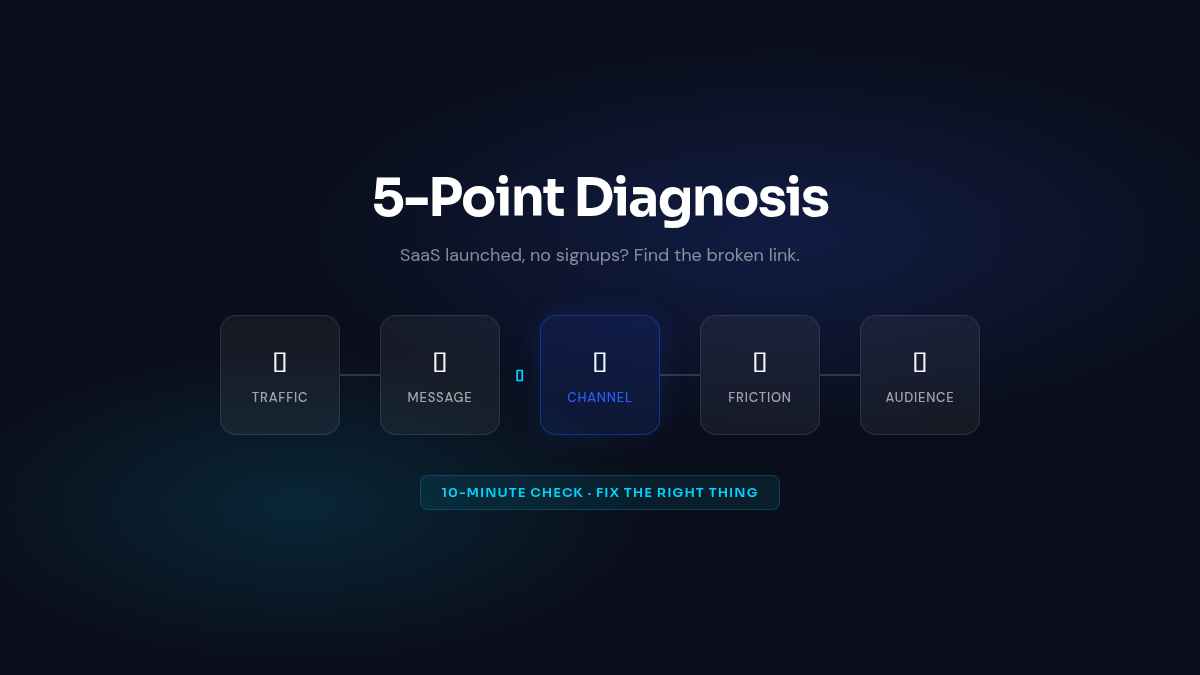
Every signup follows a chain: someone has to see your page, understand what you do, believe it solves their problem, find the signup button, and actually click it. A break at any point kills the conversion. The diagnosis is finding which link is broken.
1. Traffic: Is anyone seeing it?
If your landing page got 50 views this week, no amount of copy optimization will move the needle. The math is brutal: at a 2% conversion rate, 50 views = 1 signup. You don’t have a copy problem. You have a traffic problem.
We know this firsthand. After opening registration, CrossMind’s landing page averaged about 4 external visitors per day. Fourteen days, one signup. The conversion rate wasn’t terrible. The volume was just too low for any conversion rate to matter.
Check: Install PostHog or Plausible. Look at unique visitors, not pageviews. If it’s under 100/week, stop optimizing copy and start finding distribution channels.
2. Message: Do visitors understand what you do?
Traffic without comprehension is just bounced visits. Open your analytics and check time-on-page. Under 10 seconds average? People can’t figure out what you’re looking at fast enough.
The specific failure mode for technical founders: describing the product instead of the problem. “An AI agent that automates outreach” is a feature. “Find where your first users are” is a problem solution. We went through three positioning iterations before landing on one that matched what people were actually searching for.
Check: Show your landing page to someone who doesn’t know you. Give them 5 seconds. Ask “what does this do?” If their answer doesn’t match your intent, the message is the problem.
3. Channel: Are you reaching people with the actual problem?
Posting “I built a SaaS” in a general startup community is broadcasting. The people there are builders, not necessarily people who need what you built. You need to find the specific places where your target user is expressing the problem you solve.
Our channel data made this clear. Out of 47 registered users, only 1 came through the landing page. That one used a disposable email address with zero activity. Every active user came through a direct touchpoint: a conversation, a community thread, a warm DM. The landing page is a destination, not a source.
Check: Where did your last 10 visitors come from? If the answer is “your own Twitter” or “a link you pasted somewhere,” you haven’t found a channel yet. You’ve found a megaphone.
4. Friction: Can they actually sign up?
This one is embarrassing but common. Broken OAuth flows, email verification that goes to spam, onboarding steps that require information the user doesn’t have yet. We had users who registered, created tasks, and then couldn’t run them because the authorization path was broken. The signup worked. The product didn’t.
Check: Create a fresh account with an email you’ve never used. Go through the entire flow. Time each step. If anything takes more than 30 seconds of confusion, that’s your friction point.
5. Audience: Do the people who see it have the problem?
The hardest one to admit. Maybe the people finding your page aren’t the people who need your product. This is an ICP mismatch, not a conversion problem.
We ran 69 cold DMs to people with 500+ followers on Twitter. Zero replies. The problem wasn’t the DM format. “Has 500 followers” is not the same as “has a distribution problem.” When we switched to people who had explicitly posted “here’s what I’m building” in community threads, the reply rate jumped to 33%. Same product, same channel, different audience.
Check: Look at who’s visiting, not just how many. If your analytics show traffic from HN but your product is for non-technical founders, you have an audience mismatch, not a conversion problem.
Running the diagnosis
Go in order. Traffic first, because everything else is irrelevant if nobody shows up. Then message, channel, friction, audience. Each one takes two minutes to check if you have basic analytics installed.
| Failure Point | Check | Time |
|---|---|---|
| Traffic | Unique visitors/week > 100? | 1 min |
| Message | 5-second test with stranger | 2 min |
| Channel | Visitor sources ≠ just your posts? | 2 min |
| Friction | Fresh signup test | 3 min |
| Audience | Visitors match your ICP? | 2 min |
The most common pattern we see: founders jump to fixing message or friction when the real problem is traffic or channel. It’s easier to rewrite a headline than to find a distribution channel. But if nobody’s reading the headline, the rewrite doesn’t matter.
What to do after the diagnosis
Each failure point has a different fix:
- Traffic → Find one channel where your ICP already spends time. Don’t post about your product. Participate in the conversations they’re already having.
- Message → Rewrite in problem language, not product language. Use the words your user would type into Google.
- Channel → Stop broadcasting. Start finding specific threads and people where the problem is already being talked about.
- Friction → Remove steps. Reduce form fields. Skip email verification for the first signup. Get them to the “aha moment” faster.
- Audience → Narrow your ICP or change where you’re showing up. “Everyone” is not a target user.
The diagnosis takes 10 minutes. The fix takes longer. But at least you’ll be fixing the right thing.
If you want help mapping where your specific users are, CrossMind’s Onboarding research does that in about 30-40 minutes. It won’t fix your copy or remove friction, but it will tell you whether your channel and audience problems are real. See the distribution checklist for the full pre-launch and post-launch framework.