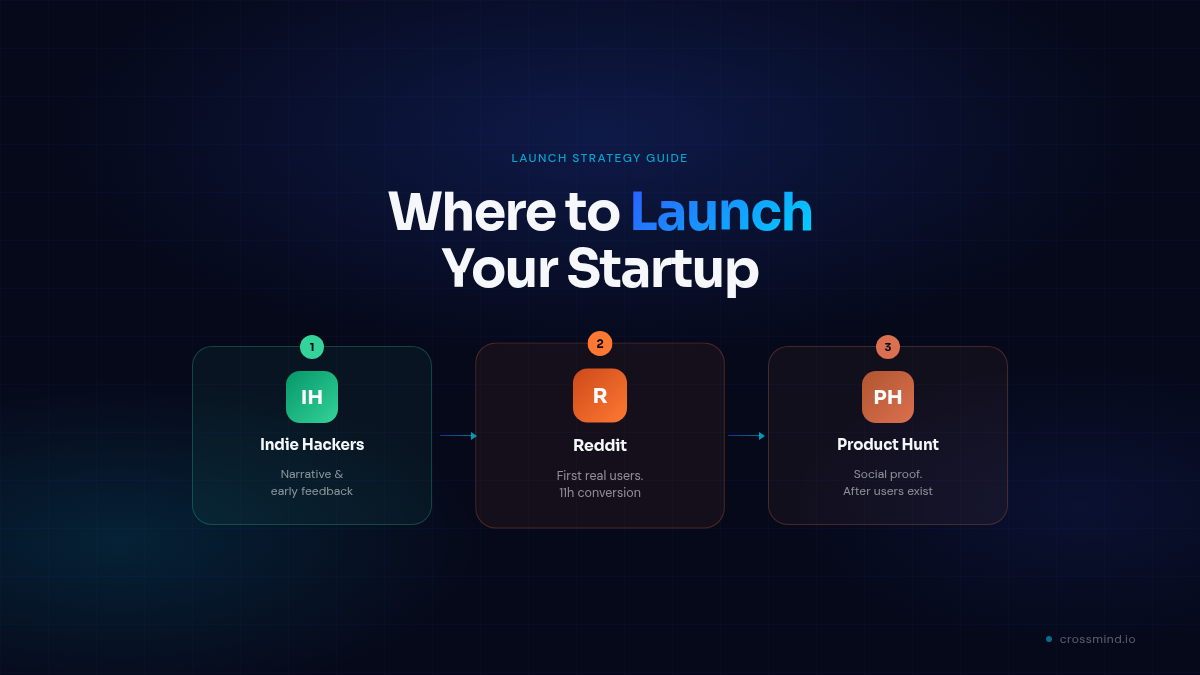
TL;DR: Product Hunt gets you visibility from other founders. Reddit gets you your first real users. Indie Hackers gets you conversation and feedback. The order most guides suggest (PH first, then everywhere else) is usually backwards. Here’s what actually changes by platform — with numbers from our own launches.
You have a product. It’s ready, or close enough. Now comes the question everyone asks and nobody answers clearly: where do you actually launch it?
The standard advice is “post everywhere.” Product Hunt, Indie Hackers, Reddit, your newsletter. That’s not wrong, but it misses the most important part: these platforms serve different audiences and deliver different outcomes. Getting the order wrong doesn’t just waste time. It burns the window you have when a launch is fresh. You get one real shot at each platform.
Product Hunt: social proof, not users
Product Hunt gets over 500 submissions per day in 2026. The front page is decided in the first 6 hours, and what moves products up is a network of makers voting for each other, not strangers discovering something for the first time.
That’s not a knock on Product Hunt. It’s just what it is: builders supporting other builders. The people who find you there are mostly other founders scouting tools and technical users comparing products, with the occasional journalist or investor doing early-stage research.
What PH does well: it confirms you exist and gives you a ranking to share. What it doesn’t do reliably: produce your first paying users.
When CrossMind launched, our Product Hunt page got traffic. But none of the registrations traced back to PH. They came from direct outreach on Twitter and a Reddit comment that started a real conversation.
Use it after you have a handful of users who can vouch for you. Launching on day one with zero social proof is playing your best card before you’ve built the hand.
Indie Hackers: good feedback, limited reach
Indie Hackers doesn’t gate new accounts. You can post on day one and get real responses, which is harder than it sounds on most platforms with karma or shadowban filters.
The audience is founders reading other founders’ stories. They know the problems you’re solving, so feedback tends to be specific rather than just encouraging. The tradeoff is volume: a successful IH post might bring a few hundred views. If you need scale, this isn’t the channel. If you need someone to push back on your assumptions, IH readers will.
We treat it as a narrative platform. The posts that work there are “here’s what we tried and what we learned,” not product announcements. Vague success stories get scrolled past. Specific numbers and honest failures get comments.
Use it early. If the post generates discussion, you can link to it when you eventually launch on Product Hunt as evidence of real traction.
Reddit: the one that actually converts
Reddit is the platform most founders either skip or use badly.
When we posted in r/Entrepreneur, our first real external user signed up within 11.4 hours. One post, one comment thread. That user became a paying customer.
The catch is “right subreddit.” Reddit is not one place. It’s hundreds of communities with different cultures, different rules, and very different tolerance for self-promotion. r/SideProject has different norms than r/Entrepreneur, which has different norms than r/startups. The subreddit where your exact user type is having conversations right now has different norms than all of them.
Founders who get burned on Reddit posted promotional content and got removed or downvoted. The ones who convert posted as community members, explained the problem their product solves in terms the subreddit cares about, and actually invited feedback.
What Reddit gives you that Product Hunt doesn’t: people actively dealing with the problem you solve, already in conversations about it. Those users convert at a completely different rate than someone browsing a discovery feed.
Our channel analysis post has the full breakdown on why Reddit worked and cold DMs failed. The short version: context does most of the selling when you’re in the right community.
Use it as a first launch platform, or in parallel with IH. Find 3-5 subreddits where your target user is active, read them for a week, then post. Don’t skip the reading step.
The sequence that works
Here’s the order that made sense for us:
Indie Hackers first. Get the narrative right. Write the actual story of what you’re building and what you’ve figured out. This forces you to clarify how you talk about your product and surfaces objections before you commit to a bigger launch.
Reddit second. Take the story you refined on IH and adapt it for a few relevant subreddits. The framing changes per community, but the core is the same. Reddit is where your first users who don’t know you personally are most likely to come from.
Product Hunt after you have proof. Wait until you have users who can leave real comments. A PH page with zero social validation is hard to upvote. Five users who can say “I use this and here’s what changed” makes a real difference.
Platforms most founders miss
While everyone debates IH vs. Reddit vs. PH, there are a few smaller platforms worth knowing:
Uneed.app runs a daily discovery format with much lower submission volume than Product Hunt. Your product gets real exposure instead of getting buried in 500 same-day submissions.
Fazier is a Product Hunt alternative where engagement per submission tends to be higher, especially for early-stage products. We’ve seen founders get more useful conversations there than from their PH launches.
Show HN on Hacker News has a high bar: your post needs a technical angle or a clearly defined problem with an interesting implementation. But for founders building tools for technical users, the audience is unmatched. Our Show HN guide covers what actually works there.
BetaList moves slower, but it reaches people who specifically seek out pre-launch products. Good for building an early signup list before you’re ready to push harder.
Picking the right platform for your product
The question isn’t which platform is best in general. It’s which one has the audience that matches who your product is actually for.
Building for technical users? Lean into Reddit developer communities and Show HN. Building for indie makers and founders? IH is more targeted than anywhere else. Building for business users or marketers? LinkedIn might outperform all three.
The mistake is treating these platforms as equivalent traffic sources and chasing raw click numbers. A hundred clicks from a subreddit where people have the exact problem you solve will convert better than a thousand from an audience with no context for what you do.
Finding where your early adopters actually are comes before deciding where to launch, not after. The platform choice follows from who your user is, not the other way around.
CrossMind’s approach is to map where your specific users cluster before running any launch. The 30-40 minute Onboarding research produces a community map — specific subreddits, Twitter accounts, and IH threads where your user type is active — before you write a single post. If you’ve launched and haven’t found your channels yet, that’s where to start.