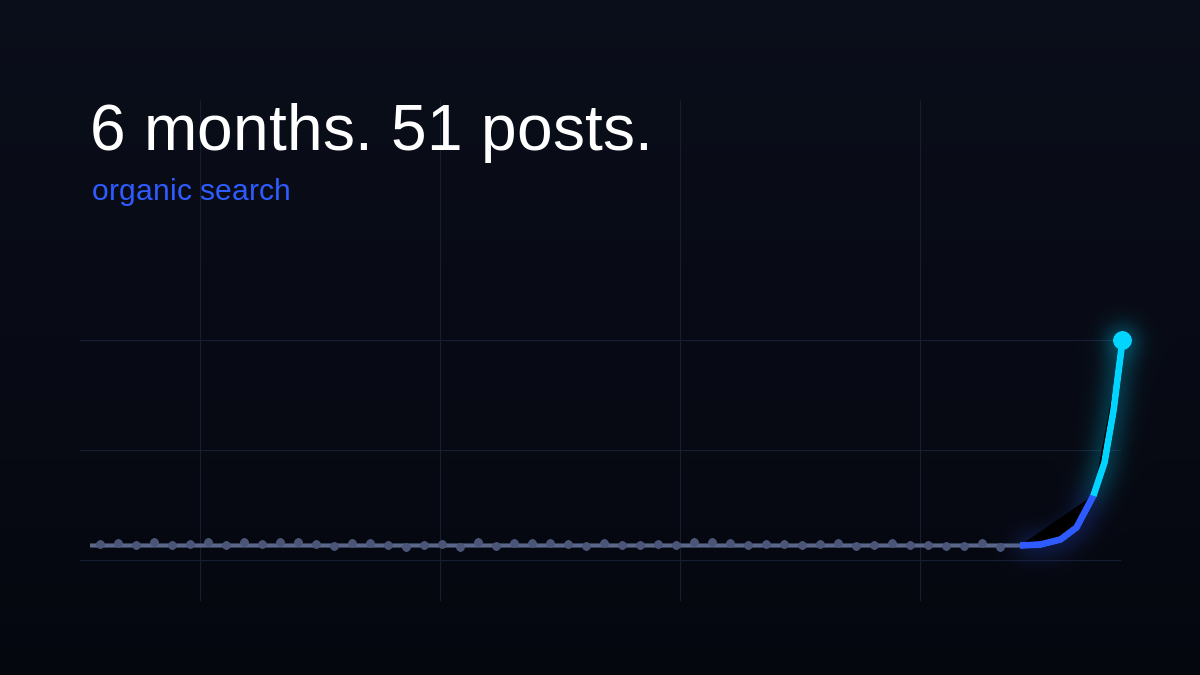
TL;DR: Six months, 51 posts, one brand-new domain with zero authority. For nearly all of that window, search sent us nothing we could measure. Two weeks ago the first confirmed organic reads arrived: 8 visits from Google and DuckDuckGo, landing on exactly 2 of the 51 posts, zero signups. Here is the complete timeline and the four rules we’d write by from day one.
The answer nobody gives you straight
Ask how long SEO takes and you’ll get some version of “three to six months” from every blog on the subject. It’s technically true and completely useless, because the sites handing out that timeline all had domain authority when they wrote it. You don’t. Nobody publishing the advice is publishing their month-by-month numbers from when they had nothing.
We just finished that stretch, so here’s what the boring middle of an SEO timeline actually looks like from a site that started from zero.
The timeline, with nothing trimmed
We started publishing in late February 2026: roughly one post every four or five days, written for founders trying to get a product’s first users. By late August we had 51 posts live. No backlinks, no existing audience, no brand searches to lean on. A YouTube channel with a similar name owns every search for our brand terms, so we couldn’t even cheat with navigational queries.
Here’s the traffic reality across those six months. Weekly pageview averages bounced between 4 and 24 a day the entire time. Our best reading was about 23.6 pageviews a day in mid-July. It then fell to 7.4 by early August despite us publishing every week, and sits near 10.6 now. Where did those views come from? Launch directories, a handful of social referrals, and people typing our URL directly. Search traffic was effectively zero for most of the window.
One honest complication: for a chunk of this experiment we were flying blind. Our Search Console connection worked during two short windows, in April and June, and has been broken since mid-June. We could count visits but couldn’t see queries or positions. That’s fixable and we haven’t fixed it, and it’s the first thing I’d tell anyone starting this: set up your measurement before post one, because you will be tempted to judge the channel during the exact months when it looks dead.
Then, on August 25 and 26, something changed. Of the roughly 20 pageviews our marketing pages got across those two days, 8 arrived through search: 5 from Google, 3 from DuckDuckGo. Small numbers, and I want to keep them small in your head. But they were the first organic search reads we’ve ever been able to confirm, and they all landed on specific posts.
What the two posts that got reads had in common
Of 51 posts, search picked exactly two.
One is our Product Hunt launch guide written for solo founders. The title is a query a person types at 11pm the night before their launch.
The other is a piece on what 16,000 MCP servers actually add up to. Concrete number, named ecosystem, a question you’d search after seeing the statistic somewhere.
The other 49 posts include diagnostic essays, personal narratives, and framework pieces. Some of them are the posts our direct readers engage with most. Search has never learned they exist. The pattern in our data matches what a widely cited Ahrefs analysis of ranking timelines found: only about 5.7 percent of new pages reach the top ten within a year, and the ones that do mostly win low-competition, specific queries. Two of 51, in month six, on long-tail queries, is that statistic happening to us in real time.
The practical takeaway we extracted: write for a query, never for a theme. The test we now apply to every draft: can you picture someone typing this title into a search box? If the title only works as an essay headline, it can rank for nothing.
The math we’d run before writing post one
Six months in, here’s the decision framework I’d hand myself in February.
Set the clock honestly. At zero authority, assume months four through six before the first confirmed search reads, and assume the reads arrive on a small fraction of your catalog. Any timeline shorter than that quietly assumes you already have authority or links.
Instrument on day one. Search Console, rank tracking, source tagging. Pageviews alone cannot tell you whether a channel is dead or maturing, and this channel looks dead for a long time before it moves.
Do the opportunity-cost math out loud. Our first 20 users came almost entirely from communities and direct outreach. Six months of content has so far produced reads and zero conversions from search. Content compounds late; conversations pay this week. If you’re pre-channel-fit, the sequence matters more than the mix: sell first, publish in the background, and judge the background bet on a six-month clock instead of a weekly one.
Where we landed
We’re keeping the blog. It runs on an agent schedule now, so the marginal cost of a post is low, and the compounding case is intact: the curve bent almost exactly when the benchmarks said it would. What changed is how we weigh the hours. The posts that earn search reads are the query-shaped ones, so those are the ones we write first, and content production was never the bottleneck anyway. The hours that actually move an early-stage product still go to finding the specific communities where your users already talk and diagnosing why a launch went quiet.
There’s a smaller lesson inside the big one. The two posts search pulled were chosen because they matched a query someone actually types, which is the same logic we apply everywhere else in growth: start from where the demand already is, then show up with something specific. Waiting for search is a six-month bet you place blind. Finding ten threads where your users complain about the exact problem you solve takes an afternoon, and it pays the same day.
If you’d rather spend this month on the afternoon version: CrossMind scans market signals and hands you a ranked list of the communities and conversations matching your product, in about 30 minutes. The output is a hit list you can act on immediately. See how it works.