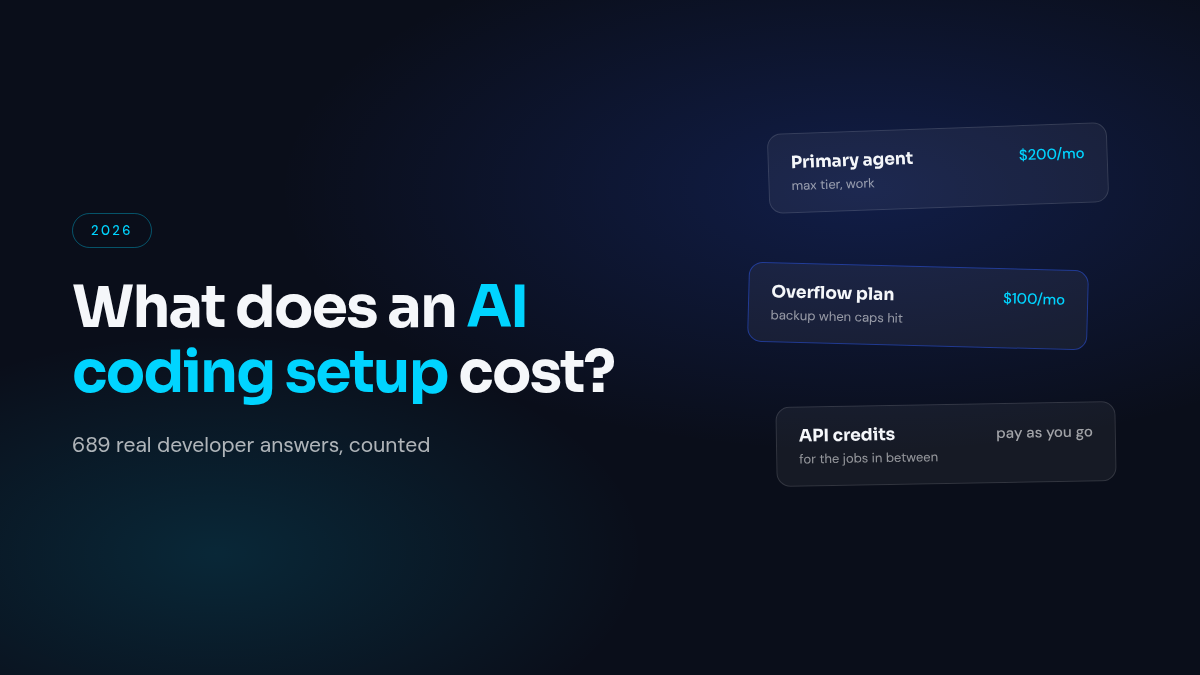
An AI coding setup in 2026 is a stack of paid subscriptions, and the stack grows for one reason: usage caps. That is what the numbers show in a recent Ask HN thread about agentic setups, which collected 558 upvotes and roughly 689 answers in four days. Of the 294 answers that named specific tools, 102 described running two or more.
TL;DR: A real AI coding setup in 2026 is a portfolio of subscriptions, usually a primary agent tool plus at least one backup. Among 689 answers, 35% of those naming tools run two or more, and most switching happens because someone hit a usage cap. Almost nobody in the thread discusses the layer where agents work on their own: scheduled runs, shared memory, or a record of what happened.
What does a real AI coding setup look like?
We counted every answer in the thread. Here is what 689 responses contain:
| What we counted | Number |
|---|---|
| Answers naming specific agent tools | 294 |
| Naming two or more tools | 102 (35%) |
| Naming three or more tools | 27 |
| Mentioning usage caps, limits, or cost | 190 (28%) |
| Mentioning scheduled or background runs | 30 (4%) |
| Mentioning memory or context sharing | 57 (8%) |
The typical stack from the answers: one primary harness, one secondary subscription, an API-key fallback for overflow, sometimes a local model for cheap jobs. One answer lists “Claude Ultra for personal, Claude Max for work, Codex $100/mo” plus OpenRouter and DeepSeek for experiments. That is four paid services feeding one workflow, and it reads as normal in the thread rather than excessive.
Why do developers switch agent tools?
The meter decides. One commenter moved from Cursor to Claude Code because they were “running out of usage on Grok 4.7”. Another says Opus 5.5 “burns through a ton of usage in Cursor so I rarely use it”. Model quality pulls people in; the cap pushes them out. Cost or usage comes up in 190 of the 689 answers, more than any other single complaint.
The spending ceiling is real at the top too. Y Combinator’s president Garry Tan told TechCrunch he spends up to $200,000 a year on tokens. Most readers of this blog will spend less, but the pattern scales down cleanly: the setup cost is now a monthly line item you manage, closer to a phone plan than a one-time purchase.
What is the stack missing?
Here is the strange result. A thread with hundreds of detailed answers about agentic setups barely discusses what agents do between typing sessions. Scheduled or background runs come up in 30 answers, about 4%. Memory or context sharing comes up in 57, about 8%. The entire conversation stays inside the window where someone is actively prompting.
The expensive questions live outside that window. What did your agents run overnight? Which of your four tools saw the context? What changed on your machine while you were asleep? Those questions have answers, they simply never show up as subscription features, so the stack keeps growing without covering them. When we audited a week of our own scheduled agent runs, 24 of 48 sessions had flagged or incomplete stops, and none of it was visible in any single tool’s dashboard.
How to keep the stack from eating your budget
- Check which tool you actually hit caps on before adding a subscription. Most stacks carry a service that overlaps another.
- Keep one primary and one overflow. Three or more paid harnesses means you are paying twice for the same tokens.
- Decide what runs unattended, then pick where its records live. That decision outlasts any subscription.
The CrossMind angle
CrossMind works on the missing layer. It connects the agents and subscriptions you already pay for into one workspace with shared memory and scheduled runs, plus a ledger of what each one did, instead of adding another subscription to the pile. Keeping multiple agents organized is a consolidation problem, and the context those agents share should survive across tools. The economics angle compounds too, since free tiers keep disappearing and consolidation is the cheaper response.
CrossMind connects your existing agents into one workspace, and every scheduled run leaves a record you can read. The output is one place that answers what your agents did across every tool you already pay for. Details at crossmind.io.