Yes, an AI agent can get your account banned. In 2026, Google restricted paid AI accounts after users connected them to third-party agents, Anthropic cut off Claude subscriptions powering the most popular agent project on GitHub, and Amazon went to court to stop a shopping agent. Below is the full enforcement timeline, and the three connection channels that survived every wave of it.
TL;DR
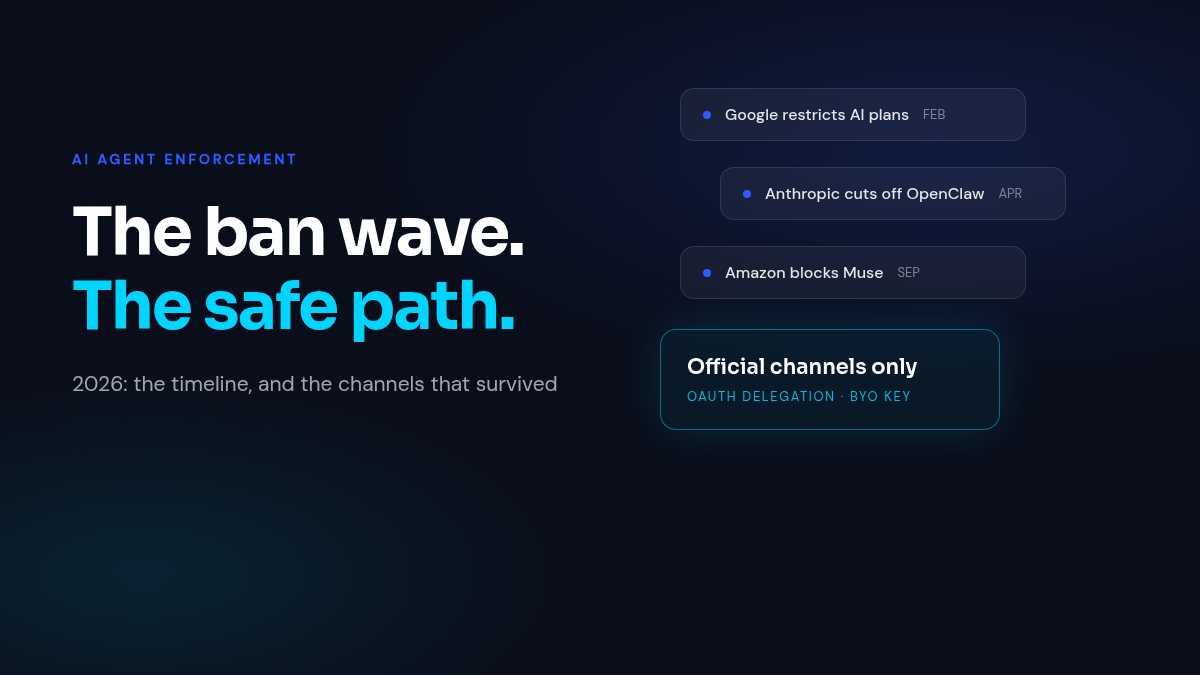
- Agent reuse exploded this year, and platforms answered: Google restricted AI Pro and Ultra accounts in February, Amazon won a court order against Perplexity’s shopping agent in March, Anthropic cut off OpenClaw in April.
- Getting allowed again did not restore trust. Nine days after Anthropic reopened OpenClaw-style usage, users reported Claude Code refusing or repricing commits that mentioned the project.
- The unofficial channel fails twice. It violates terms, and it runs on copied session tokens that put your whole account at risk. A privilege-escalation CVE landed the same day as the ban announcement.
- Three channels survive: OAuth delegation through official integrations, bring-your-own API keys, and the first-party agent portals platforms are starting to build.
Why platforms started banning agents
Start with the numbers. In January, an open-source personal agent called OpenClaw went mainstream, and by March 2 it had become the most-starred software project on GitHub, ahead of React. Developers discovered they could point a general-purpose agent at the subscriptions they already paid for: their Claude account, their Google AI plan, their retail logins.
The appeal is obvious. You already pay for these services. An agent that quietly logs in as you and works while you sleep costs nothing extra. Nobody signs up for a $200 plan expecting it to stay locked inside one vendor’s apps.
Platforms saw the same usage from the other side. From their position, an agent logging in with your session credentials looks like a scraper with your password. It consumes quota you subsidized for personal use, it acts without the audit trail their own clients produce, and when it misbehaves, support tickets land on them. February is when patience ran out.
The 2026 enforcement timeline
The hits came in three forms: restrict the subscription, sue the agent, block the crawler.
| Date | Platform | What happened |
|---|---|---|
| Feb 22 | Users reported AI Pro and Ultra accounts restricted after OAuth use through OpenClaw (802 points, 705 comments) | |
| Mar 2 | GitHub ecosystem | OpenClaw became the most-starred project on the site, ahead of React |
| Mar 10 | Amazon | Court order blocking Perplexity’s AI shopping agent from the retail site |
| Apr 3 | Anthropic | ”Tell HN”: Claude Code subscriptions no longer allowed to power OpenClaw (1,099 points, 827 comments) |
| Apr 3 | OpenClaw | Privilege-escalation vulnerability CVE-2026-33579 published the same day |
| Apr 21 | Anthropic | OpenClaw-style Claude CLI usage conditionally allowed again |
| Apr 30 | Anthropic | Users reported Claude Code refusing requests or charging extra when commits mention “OpenClaw” (1,349 points, 720 comments) |
| Sep 21 | Amazon | Meta’s Muse shopping agent blocked from the retail site |
Two things stand out in that table. First, enforcement did not stop after the headlines moved on. September’s Muse block shows platforms treat agent access as an enforcement area that outlasts any news cycle. Second, the actions target the connection method, and every one of them went after the same thing: agents reaching paid services through channels the platform never approved.
”Allowed again” lasted nine days
Anthropic’s April 21 reopening looks like a happy ending, and OpenClaw’s own provider docs now describe Claude CLI usage as permitted. Nine days later, a thread claiming Claude Code refused requests, or quoted higher prices, when commit messages mentioned the project outscored the original ban announcement: 1,349 points against 1,099.
Whatever the precise mechanics behind that incident, the sequence is the lesson. Access came back with conditions, the conditions were opaque, and users started suspecting enforcement by keyword. When a string in your commit message can flip your pricing, the stable contract is gone. What’s left is a relationship where the other side holds every card, and you will find out about rule changes from your own error messages.
Running your workload through a channel like that is a business decision you made for someone else’s convenience. The subscription you “saved” costs you a re-platforming exercise the day enforcement tightens again.
The security floor under the gray channel
Set the terms-of-service question aside, and the gray channel still fails on its own merits. This year’s record, all from before any ban wave:
- In February, the most-downloaded skill in ClawHub, the ecosystem’s skill marketplace, was found to contain malware.
- In March, a widely shared write-up catalogued the attack surface and called the project “a security nightmare dressed up as a daydream.”
- On April 3, the same day Anthropic announced restrictions, a privilege-escalation vulnerability in OpenClaw itself was published and picked up 514 comments on Hacker News.
The mechanism underneath these incidents is simple. Gray-channel reuse works by copying your logged-in session tokens out of your browser and replaying them. Those tokens are full-account credentials: unscoped, unrevocable without logging you out everywhere, and invisible to the platform’s abuse systems. Hand them to an agent framework and every plugin, skill, and integration in its supply chain now holds the keys to your account. The CVEs are what happens when a fast-moving extension ecosystem routes full credentials through everything it touches.
Three channels that survive the ban wave
- OAuth delegation through official integrations. The platform issues a scoped, revocable token to a named, approved integration, and you can see it and cut it off. This is the channel every platform tolerates today, and the one the enforcement waves steered everyone toward.
- Bring-your-own API key. You pay metered rates as an API customer, the agent authenticates as itself, and your consumer account never touches the automation. It costs more than subscription reuse, and it comes with a real contract instead of borrowed access.
- First-party agent portals. Walmart is building agentic shopping directly with OpenAI, and platforms under pressure to formalize agent access are opening sanctioned lanes instead of fighting every agent individually. Early and uneven, but this is the direction enforcement is herding everyone toward.
The test for any setup someone offers you: if connecting it requires copying a token out of your browser session, you are on channel zero, the one every row in the timeline above was about.
Where we landed on this
CrossMind connects to the agents you already run, which puts us squarely in the reuse business. That is exactly why our aggregation layer only touches the three channels above: official integrations, OAuth delegation, and your own API keys. No copied session tokens, ever. An aggregation layer built on the gray channel would be one terms-of-service sweep away from zero, and our whole bet on keeping the agents you already have assumes the opposite of fragility.
The same thinking drives our position on agent approvals: reuse is only worth it when you can see what the agent is doing and pull the plug, which is why we build consent and permission gates as product features instead of buried settings. If you are weighing an agent setup against your paid accounts, run the channel test first, then decide where the agents themselves should live. CrossMind connects your existing agents through sanctioned channels in minutes, and the output is your own agents working on your accounts with nothing in the terms waiting to take it away.