TL;DR: Getting a signup and getting a paying customer are two different problems, and most “first users” advice only solves the first one. Your first paying customers almost never come from your broadest channel. They come from the people who already felt the value. Here’s the framework, plus the onboarding decision that moved our payment step earlier because free-first wasn’t converting.
A founder messaged us last month with a number he was proud of: 80 signups in three weeks. Then the quieter part. Zero of them had paid. He’d done everything the “first users” playbooks told him to. He just assumed paying customers were the next signup away.
They weren’t. Getting your first paying customers is a separate job from getting signups, and treating them as the same thing is why a full waitlist can sit next to an empty bank account.
Why signups don’t turn into paying customers
A signup is a low-cost yes. Someone liked your tweet, your landing page, your launch post enough to type an email. That yes costs them nothing, so it predicts almost nothing about whether they’ll pay.
We learned this the blunt way. One of our early signups came in through the landing page with a disposable email address. Zero activity after that. Never opened the product, never came back, obviously never paid. That account is the perfect illustration of the gap: a signup that was never going to become a customer, and no amount of email nurturing would have changed it.
The broad channels that are great for raising your signup count are usually the worst for revenue. Cold traffic converts to free easily and to paid almost never. So the first thing to accept is that your signup number and your paying-customer number are measuring two different things.
Where first paying customers actually come from
When we mapped where our first real users came from, the pattern was clear: the ones closest to paying were the ones who’d had the highest-touch path in. Personal referrals, direct outreach conversations, the people we’d actually talked to. The channel breakdown of our first users showed the same thing the landing page did, just from the other direction. Effort in correlated with intent out.
This is uncomfortable because it doesn’t scale, and founders want the scalable answer first. But your first ten paying customers are not a scale problem. They’re a conversation problem, the same way your first ten users are. The difference is that for paying customers, the conversation has to reach the moment where money is a reasonable ask.
Put the paid moment where the value lands
Here’s the decision that changed things for us. Our original onboarding was free-first: sign up, poke around, maybe pay later. “Later” almost never came, because nothing in the flow forced a moment where the value was undeniable.
So we rebuilt it. The new flow goes: you give us your product URL, we run the research and hand back a real output (where your users are, which communities, which accounts), and the payment step sits right after that output. Not before you’ve seen anything. Not buried three sessions later. At the exact moment you’ve just watched the thing do useful work.
That’s the principle: charge at the point of demonstrated value, not before it and not long after. Ask too early and you’re selling a promise. Ask too late and the value has already faded into the background. Your first paying customers convert when the bill arrives while the “oh, that’s actually useful” feeling is still fresh.
A framework for your first ten paying customers
You don’t need a pricing page optimization project for this. You need to do four things deliberately.
Qualify for willingness to pay, not just interest. When someone signs up, the question isn’t “do they like it.” It’s “do they have the problem badly enough to pay for it.” A founder losing sleep over zero users is a different prospect from someone idly curious about AI tools. Spend your time on the first kind.
Find the value moment and stand next to it. Identify the single point in your product where a user goes from skeptical to “okay, this works.” That moment is where the paid ask belongs. For us it’s the research output. For you it might be the first generated report, the first booking, the first integration that fires. Map it, then make sure the path to paying runs straight through it.
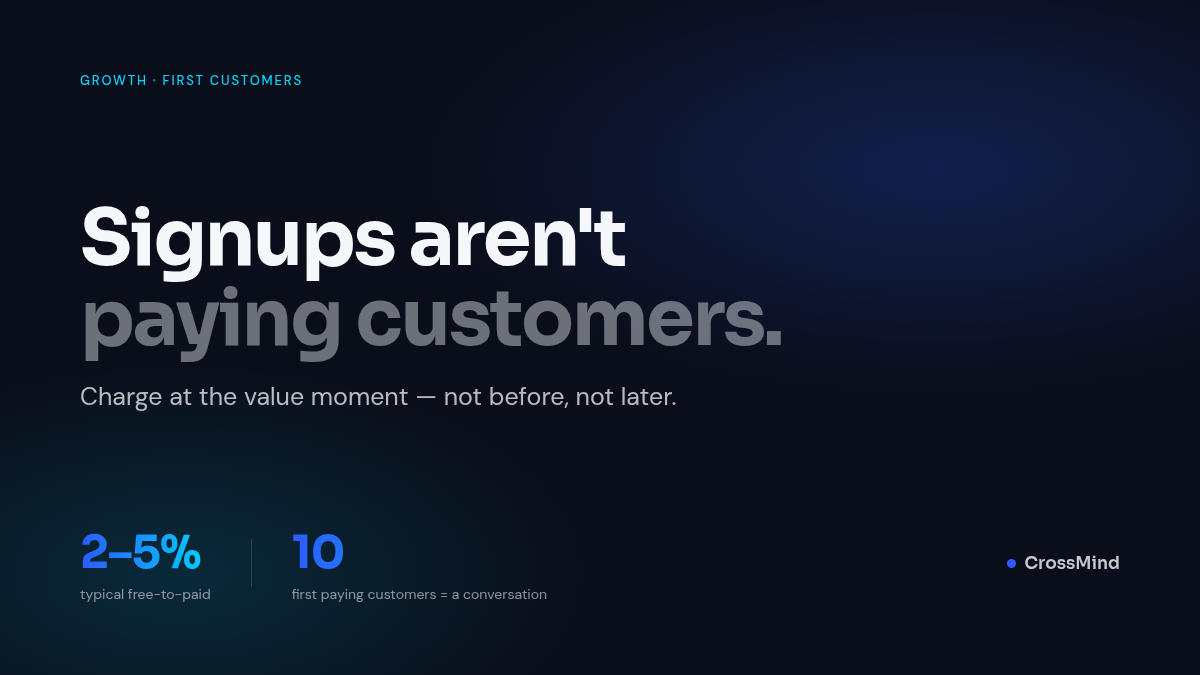
Charge real money early. A free tier with no forcing function teaches users that your product is free. Industry freemium free-to-paid conversion sits around 2–5% (OpenView’s SaaS benchmarks), and that’s for companies with real funnels. At the start, a small paid commitment from the right person tells you more than a hundred free signups.
Talk to the ones who don’t pay. Every founder studies the customers. The non-converters are where the information is. When someone hits your paid step and bounces, that’s the most honest signal you’ll get about whether the value moment actually landed. Ask them. The answers usually point at one of the three things above.
The number that actually matters
It’s tempting to track signups because the line goes up and to the right and it feels like progress. But signups are a vanity number until they convert. Our own north-star metric is paying users, not registrations, specifically because registrations lied to us once already.
If you’re sitting on a pile of signups and no revenue, you don’t have a traffic problem and you might not even have a product problem. You have a value-moment-meets-payment problem, and it’s fixable without finding a single new user.
CrossMind exists to do the front half of this for founders: it researches where your real prospects are and runs the outreach that brings in the high-intent users who actually convert, instead of the disposable-email kind. The output is a list of real places your buyers already are and the contact already started. Your job is to make the value moment undeniable when they arrive. See how it works.