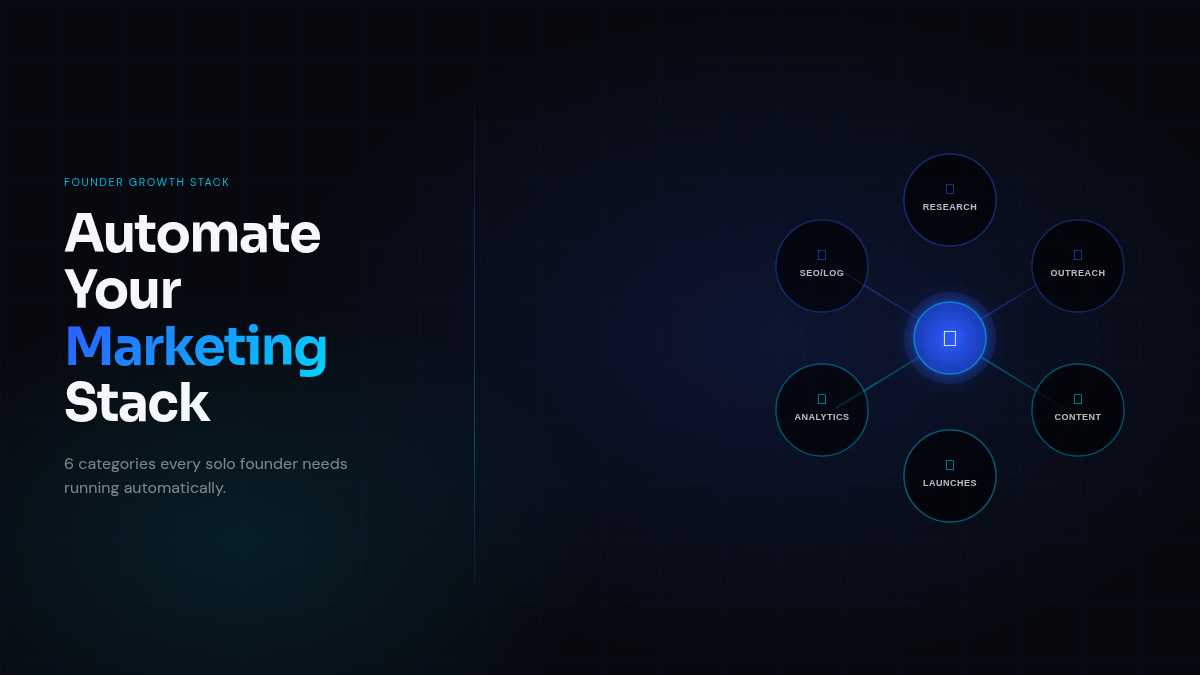
TL;DR: The six marketing categories worth automating for a zero-to-one startup are: community research, outreach, content distribution, launch submissions, analytics, and changelog/SEO. Most founders automate zero. The ones who close the loop fastest automate all six.
Search “how to automate startup marketing” and you’ll find advice built for teams that already have demand. Set up a drip email sequence. Schedule your posts. A/B test your CTAs. Good advice, if you already have traffic.
Most founders reading this don’t have traffic. They have a product, a landing page, and the slow realization that building was the easy part. Marketing automation for a zero-to-one startup is a completely different problem: you’re not nurturing leads, you’re finding the first ones. You’re not scheduling content, you’re figuring out what anyone cares about.
Here’s what actually needs to run automatically, and what it looks like in practice.
Why most founders automate the wrong thing first
The instinct is to automate what’s visible: social posts, email sequences, maybe a chatbot. These feel like marketing. But for a founder with fewer than 50 users, they solve the wrong layer. The classic example: you set up automated posting, but you have no idea where your users actually are.
Scheduled tweets don’t tell you where your users actually are. Email sequences don’t find people who’ve never heard of you. The work that matters at this stage is upstream: research, discovery, outreach, and distribution.
When we mapped CrossMind’s own marketing operations, six distinct categories emerged. They’re not the six that most “marketing automation” articles cover. But they’re the ones that actually determine whether you find your first 100 users or stay stuck at 10.
The six categories
1. Community research
This is the one most founders skip entirely because it doesn’t feel like output. No post gets published, no email gets sent. But it’s the foundation of everything else.
Community research means scanning where your target users already spend time: Reddit, Hacker News, Indie Hackers, Twitter threads, Discord. The goal is finding the people who are already describing your exact problem. Not as a one-time exercise, but as a continuous feed.
In practice, this looks like: identifying 20+ communities relevant to your product, scoring them by activity and ICP match, and pulling the highest-value conversations (threads where people are asking for exactly what you built) into a working list. Running this manually every day is impossible. Automated, it surfaces signal before your competitors even see it.
For CrossMind’s own Onboarding, this research phase takes 30-40 minutes and produces specific subreddits, Twitter accounts, and Indie Hackers threads where founders with the “launched to crickets” problem are active. Not a list of categories; actual URLs you can open today.
2. Outreach
Outreach automation is the category most founders have tried and most have gotten wrong.
Cold DM automation (blasting the same message to 100 accounts) produces a 0% reply rate. We know because we ran 69 iterations and got exactly that. The full breakdown of what we learned from cold DM failure vs. warm outreach success explains why the method matters more than the channel.
The outreach worth automating is context-aware: finding posts where people self-identify as your target user, engaging publicly first, then following up when there’s an established relationship. For CrossMind, this means scanning Twitter for founders who drop product links in “what are you building” threads, engaging with their posts, waiting for a mutual follow, then sending a targeted message referencing their specific product.
That approach, which we call the X Drop Pipeline, produced a 33% DM reply rate across 103 messages sent. Six of those became registered users. The automation isn’t doing the same thing faster; it’s doing a smarter thing at scale.
3. Content distribution
Publishing content and distributing content are separate operations. Most founders handle them as one: write a post, share it in two places, move on. That’s manual, inconsistent, and doesn’t compound.
Automated content distribution means once a piece of content exists, it gets pushed to the right channels with the right format for each. A blog post becomes a Twitter thread summary, a LinkedIn post, a Hashnode syndication, and a Hacker News link, each formatted for the platform.
CrossMind runs 34 blog posts across this distribution pipeline. Traffic from organic search is still building (these things compound slowly), but the publishing cadence is consistent without daily founder involvement.
4. Launch submissions
Submitting your product to launch directories like Product Hunt, Uneed, Fazier, BetaHunt, and BetaList is straightforward but slow. Each platform has different format requirements, community norms, and timing conventions.
A single submission manually takes 30-60 minutes. Across six platforms, it’s a multi-day project most founders deprioritize indefinitely. Automated, assets get prepared, submissions go out in parallel, and follow-up comments get queued automatically.
We built CrossMind’s own launch infrastructure to handle this. The automation doesn’t just submit. It monitors upvotes, responds to comments, and flags when a launch starts gaining traction so the founder can engage at the right moment.
5. Analytics and weekly reporting
The most underrated automation: knowing what’s actually happening.
Founders who check analytics ad hoc see noise. Founders who get a structured daily report comparing traffic to the 7-day average, with anomaly detection, make faster decisions.
Our PostHog setup generates exactly that. Yesterday’s report showed 9 pageviews against a 21.9 average, which flagged today as a day to publish. Not something we’d have caught by manually logging in.
The goal isn’t more data. It’s data arriving at the right moment to change the next decision.
6. Changelog and SEO maintenance
This one is specific to builders but high-value: automated changelog generation from git commits.
Every day you ship code, there are changes worth documenting. Most founders skip this entirely because there’s no process in place. But a changelog that updates daily does two things: it signals to users that the product is alive, and it creates fresh indexed content that search engines reward.
CrossMind generates a new changelog entry from each deployment, with an AI-generated summary and cover image. The blog (34 posts) and changelog together maintain a content cadence that no solo founder could sustain manually.
SEO maintenance (checking title tags when a post starts ranking, fixing internal links, monitoring for indexing issues) runs on a similar cycle. Not daily, but triggered by signals rather than a calendar reminder.
What this stack actually requires
Running all six categories manually would take a full-time person. But they’re not exotic categories; they’re just the complete set of what “marketing” actually means before you have a growth team.
The question isn’t whether to automate them. At the zero-to-one stage, most founders can only sustain one or two manually. The question is which one to start with, and how to close the loop between research → outreach → content → analytics.
For CrossMind users, the starting point is community research: map where your ICP is, produce specific leads, then run outreach from that map. The community research output from a real Onboarding run shows what that actually looks like. The other categories layer in as the product gets traction. But research-first matters because it shapes everything downstream. Outreach without research is cold spam. Content without research is posting into a void.
The pattern across successful founder-led growth
When we traced the acquisition path of each of CrossMind’s 47 registered users, one pattern appeared: every user who converted had seen some form of founder presence in a place they already were. Not an ad or cold message. A post in a thread they were already reading, or a referral from someone they knew.
Automating that presence, consistently across these six categories, is what “marketing automation” actually means at the zero-to-one stage.
The drip emails can wait. The community map cannot.
CrossMind runs these six categories autonomously for founders, starting from a product URL. Community research output typically takes 30-40 minutes on the first run. See how it works →