Every launch checklist now carries a new line item: optimize for AI search. The tools selling GEO audits pitch ChatGPT referral traffic as the next Google. We publish a 64-post blog on a low-authority domain and logged every referral for nine months. Our complete haul from AI assistants: seven visits from ChatGPT, zero from Perplexity, Claude, Gemini, Copilot, or Grok. All seven went to the homepage. Google sent us 26 visits in the past week alone.
TL;DR: From February 1 to November 14, crossmind.io took 2,270 visits. AI assistants sent 7 of them (0.3%). Every one came from ChatGPT, every one landed on the homepage, and none touched a blog post. Treat answer engines as a citation surface you prepare cheaply, keep your traffic work on human channels, and check your own referral filter monthly until the curve shows up.
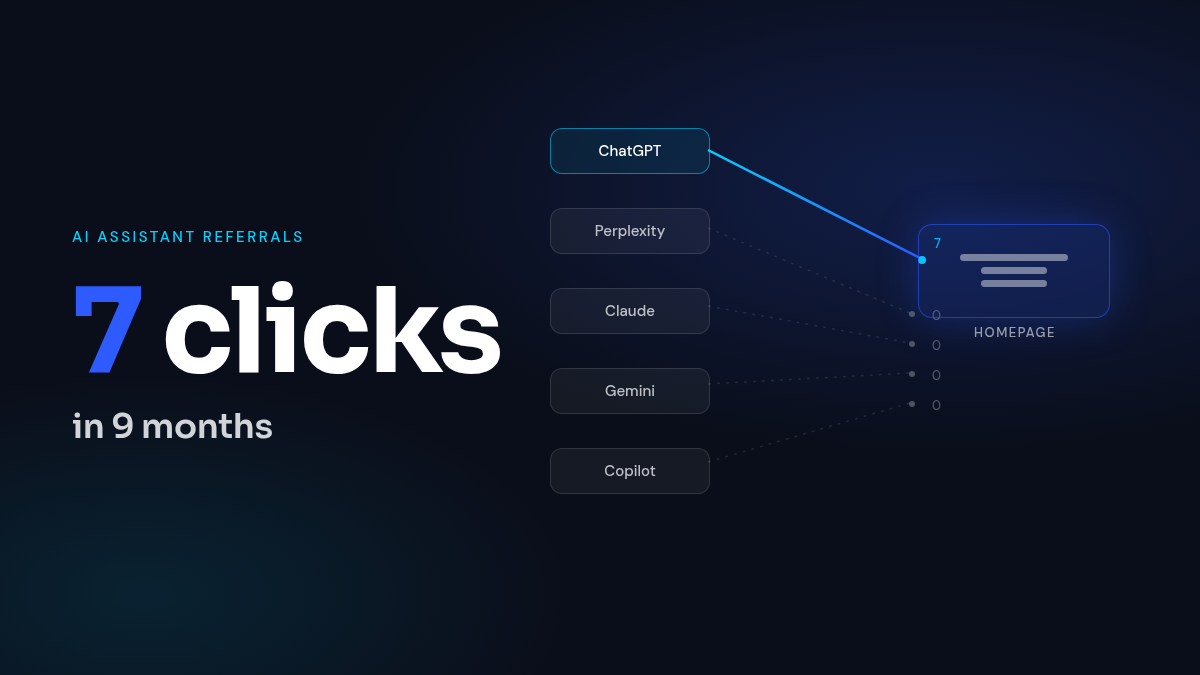
Where does ChatGPT referral traffic actually show up?
Here is the full referral table for our domain, February 1 through November 14:
| Referrer | Visits, Feb 1 – Nov 14 |
|---|---|
| ChatGPT | 7 (0.3% of all visits) |
| Perplexity | 0 |
| Claude | 0 |
| Gemini | 0 |
| Copilot | 0 |
| Grok | 0 |
| Google (last 7 days only, for scale) | 26 |
Two context numbers make the table honest: 2,270 total visits and 757 of them on blog posts. The attribution is unambiguous because 6 of the 7 ChatGPT visits carried ?utm_source=chatgpt.com, the parameter ChatGPT appends when it renders a link inside an answer. These are answer-link clicks, so there is no guessing about whether a human pasted the URL manually.
What were the 7 clicks actually worth?
Five of the seven landed on the same day, August 19. Every click pointed at the homepage. None landed on any of the 64 posts.
The fact ends there. With seven data points, any mechanism story is directional at best. What the pattern suggests: when an assistant mentioned us, it recommended the product by name and the reader clicked the domain. That kind of mention comes from sources that describe products, such as launch directories, comparison roundups, and community threads (our launch platform results live in exactly those places). No article we wrote produced a single AI-assistant click in nine months.
A homepage click is also a different event from a blog click. A blog click is a reader with a question, and the article either answers it or fails. A homepage click is someone who already heard the product name somewhere and is now checking whether it exists. The first builds authority over months; the second is a name-recognition echo. Measuring them in the same column, as most “AI traffic” dashboards do, hides which one you actually earned.
What does industry data say about AI search referrals?
Our tiny numbers match a pattern the measurement firms already documented. Similarweb’s generative AI stats report (July 29, 2026) found that roughly six in ten AI-referred visits land on a homepage instead of the specific page the assistant cited. Citation rates in US prompts grew from 1.6% to 6.8% between June 2025 and May 2026, and monthly generative AI visits grew 70% year over year to 9.5 billion. The layer is real and growing. Its click routing stays homepage-heavy and concentrated on a handful of big domains.
Ahrefs’ AI Overviews study (February 2026) adds the other half: AI Overviews cut organic CTR for position-1 results by about 58%, and pages cited inside AI answers earn roughly 35% more clicks than pages left out of them. For a small site, both effects point in the same direction. Being extractable and citable is worth doing now. Waiting for assistant click volume to matter, at our scale, is premature.
The honest caveat: our domain is small and our brand term is dominated by a YouTube channel with hundreds of thousands of subscribers. A site with real authority would show a different denominator. What transfers at any scale is the shape of the pattern, homepage-heavy clicks, brand-level mentions, and article content that earns citations without earning clicks, and that shape is exactly what Similarweb measured across much larger sites.
Should founders optimize for AI search yet?
A three-step test we now run on ourselves:
- Set the referral filter once, then check it monthly. Tag or regex the
utm_sourcevalues your analytics receives and watch the AI-engine slice separately. This takes about ten minutes and replaces every “is AI search sending traffic?” guess with a number. If you want the audit trail alongside it, we built exactly that for our own scheduled agents. - Keep feeding the citation sources. Assistants quote what launch directories, comparison roundups, and community threads say about products. That is the same channel list your human readers use, which is why our channel map still holds: one list of channels now serves two readers. A Product Hunt listing raises the odds an assistant names you when someone asks about tools like yours. So does a Reddit thread that genuinely answers a question.
- Make your content liftable. Answer the target question in the first paragraph, put hard numbers in a table, and write H2s as sub-questions. Nothing about that hurts Google rankings, so the work only pays twice if assistant citation grows.
What we changed after seeing our own numbers
We declined to add a GEO workstream. Budgeting for “AI search traffic” as a KPI, while our filter shows seven clicks in nine months, would be paying for a curve that has not arrived. What did change: every new post on this blog now answers its target query in the opening paragraph and carries at least one hard-number block, because the citation side is already measurable on the industry side.
The weekly publishing cadence and the query-exact titles stay untouched. Google organic is still the only channel here that sends visits on a schedule you can feel, and its timeline for a new site is slower than most founders expect. If your launch reads as silence, the checklist in our crickets post is still the fastest way to find which leg is broken.
That referral audit runs on a schedule here, and it runs the same way for you. CrossMind queries your product analytics weekly, filters crawler and parameter noise, and writes the AI-assistant slice into your traffic dashboard. The output is a one-read answer to “what actually sent traffic this week.” crossmind.io