Most founders who land here have already wasted time on the obvious stuff. A Product Hunt launch, a Reddit thread, maybe a batch of cold DMs. The question they’re really asking isn’t “can AI help with growth?” They know it can. The question is: can it tell me where my users actually are, or is this just another tool that does what I’d do manually, only faster?
Fair skepticism. Here’s what automated community research actually looks like.
The problem isn’t automation — it’s skipping the research
Most AI tools marketed as user acquisition tools skip the hardest part. “Automate your outreach” assumes you already know which communities to target, which conversations to enter, which phrases your users type into Google when they’re stuck. Most founders don’t. They guess, spend a week in the wrong subreddit, see nothing happen, and conclude Reddit doesn’t work.
Reddit worked fine. The research was missing.
When we ran CrossMind’s own onboarding research (using CrossMind to find CrossMind’s early users), it came back with 5 matched communities, 20 specific Reddit post links, and 15 target Twitter accounts. Total time: 38 minutes. That output is what we used to decide where to spend the following week. Not a spreadsheet we put together ourselves. The research ran while we kept building.
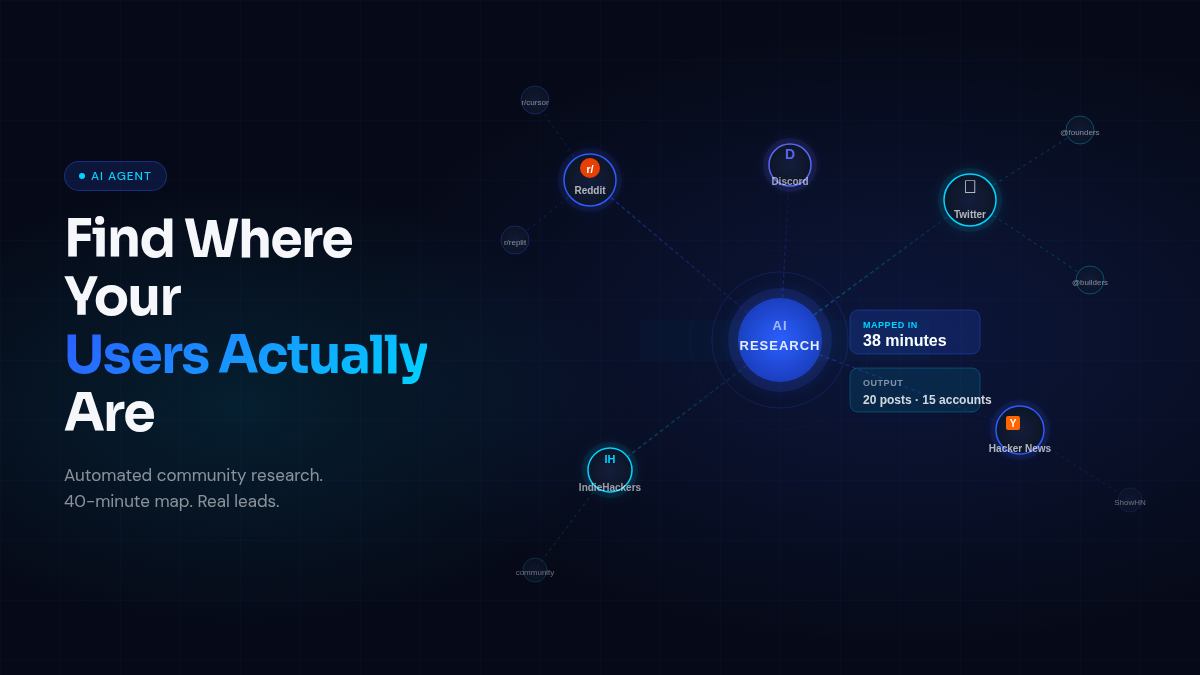
The two-axis framework
The research runs on two axes. Most founders only think about one.
Axis 1 is builder toolstack communities. Who builds the way your target users build? If your product is for founders using Cursor, Replit, or Lovable, those builders are your warmest possible early adopters. They share your assumptions about moving fast with AI. They’ve hit the same “launched to crickets” wall. They’re the people most likely to get what you built without a lengthy explanation.
Communities on this axis: Cursor’s Discord, r/replit, Lovable’s community, specific Hacker News threads about vibe coding.
Axis 2 is problem domain communities. Where does your target user go when the problem your product solves is actively frustrating them? If you’re building for podcasters, you want r/podcasting, not r/entrepreneur. The people in r/entrepreneur might become customers eventually. The people in r/podcasting are dealing with the problem today.
Most founders stop at Axis 2. They look for communities that feel relevant to their product category. That’s not wrong, but they completely miss Axis 1, which is where the fastest early feedback actually lives.
CrossMind’s research runs both simultaneously, scores communities by activity level, post density, and match to your specific product, and returns a ranked list with reasoning for each.
What the output contains
After the research runs (30 to 40 minutes on average), you get four things to act on in the next seven days.
Five matched communities, each with: why it matches, how active it is, what kinds of posts tend to get engagement, and whether it’s more of a builder audience or a problem-experiencing audience.
Twenty specific Reddit posts. Not subreddits. Specific threads where someone is already experiencing the problem you solve, and where a useful comment would be welcome. Each one includes the URL, how old the post is, and why it scored as a match.
Fifteen target Twitter accounts. People who post repeatedly about the exact frustration your product addresses. Not broad influencers in your space. Accounts worth watching for new threads and comment opportunities.
A first-week execution plan. What to do with all of the above, in order.
The onboarding flow
This research is what happens at the start of every CrossMind onboarding:
- You give us your product URL and one sentence about what you’re building
- CrossMind runs the two-axis research for 30 to 40 minutes
- You receive the community map, post list, and account targets
- You see the output before you pay anything
That last part is intentional. You don’t pay for something you haven’t seen yet. If the output maps communities you’ve never heard of, posts that actually match your ICP, and accounts you’d want to monitor anyway, you know what the next week looks like. If it misses, you haven’t committed to anything.
The discount (Hobby plan at 30% off for first-time subscribers) triggers after the onboarding, not before. The research is the pitch.
Why this is different from asking ChatGPT
Generic AI can find communities. Ask ChatGPT where productivity founders hang out and you’ll get a list of subreddits. The list will be accurate. It’ll also be the same list for every productivity tool, which makes it useless.
The two-axis framework produces a different output because it starts from your product’s specific position: what tools you built it with (Axis 1), what problem it solves (Axis 2), and what language your actual users use when they’re frustrated (pulled from the research itself).
The result is specific to your product, not your category. CrossMind’s own research didn’t return r/entrepreneur and Product Hunt. It returned specific subreddits for Cursor users, specific HN threads about vibe coding distribution problems, and specific Twitter accounts who post about “launched to crickets.” That’s a different output than a category search.
What comes after research
Community mapping is the starting point. Once it’s done, CrossMind’s ongoing execution covers daily monitoring of those five communities for new posts worth engaging with, context-matched comments and replies on Reddit and Twitter, coordinated submissions to launch directories, and content going out on X, LinkedIn, DEV.to, and Hashnode.
Without the research, that execution is spray-and-pray. With a community map, every action has a specific target.
The real question
Founders asking about AI agents for user acquisition are usually asking one of two things.
“Can this replace a growth hire?” At pre-PMF, your growth problem is research and channel discovery, not campaign optimization. That’s where this is most useful.
“Can it tell me something I don’t already know?” Yes, specifically on Axis 1. Most founders know their problem-domain communities. They don’t know which builder-toolstack communities have the warmest early adopters for their particular product.
If you’ve launched and you’re not sure where to start looking, the research comes first. Not the outreach. Not the content. The map.
CrossMind runs that research in 40 minutes. See what it finds for your product
Related: Where to Find Early Adopters: A Real Channel Map | Why Zapier Won’t Find You Users | Launched to Crickets: A Distribution Checklist