TL;DR: Interacting with an AI agent isn’t the same as deploying one. If your agent stops when you stop talking, you’re feeding it — not using it. Real usage means the agent ships work while you sleep.
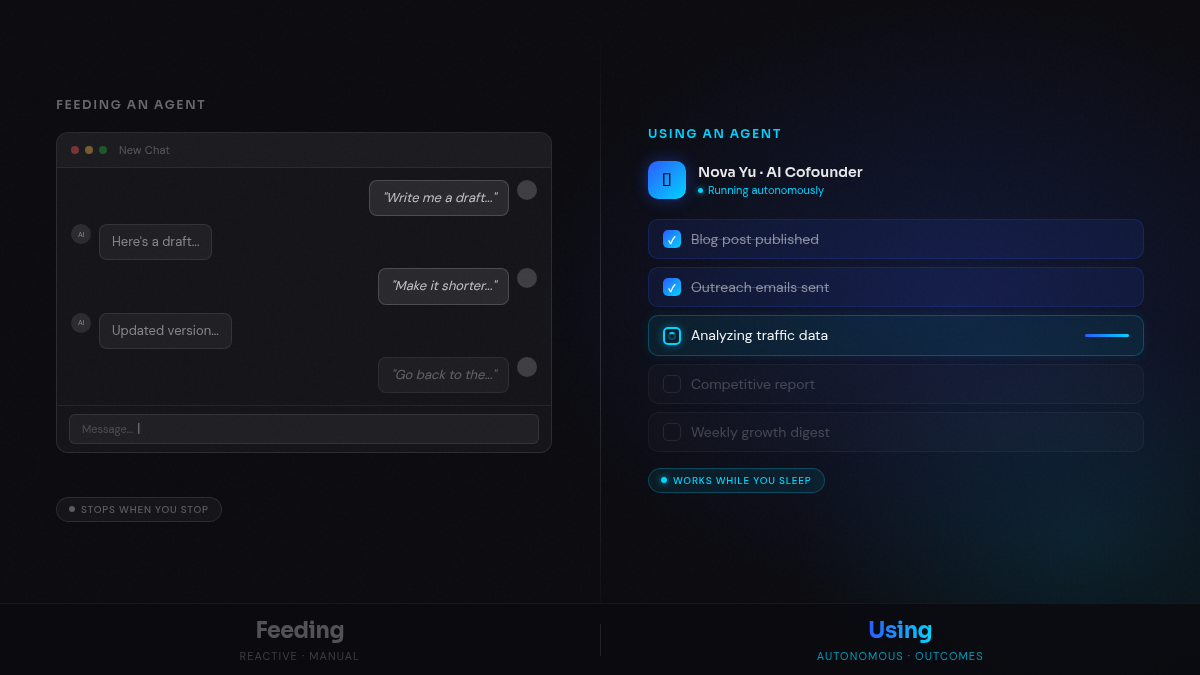
Here’s an uncomfortable question: when was the last time your AI agent did something useful without you asking?
If you had to think about it, that’s your answer.
The Feeding Trap
There’s a word for the kind of AI interaction most people have: cultivation. You tend to the agent. You prompt it, guide it, correct it, prompt it again. You’re the engine; the AI is a powerful typewriter that needs constant fuel.
This isn’t wrong — but it’s not the productivity promise anyone signed up for.
McKinsey’s CEO recently revealed the company now runs 20,000 AI agents alongside 40,000 human employees. The key word is runs — not talks to, not prompts, not feeds. Those agents execute tasks on defined schedules, handoff work between sessions, and generate output without a human in the loop on every step.
That’s a different thing entirely from opening a chat window and asking for a first draft.
The Productivity Test
Ask yourself three questions:
- Does your agent remember what happened last session — without you summarizing it?
- Does your agent take actions you didn’t explicitly request but clearly should?
- Does your agent ship output on a schedule, not just on demand?
If you answered no to all three, you have a very sophisticated autocomplete tool. Useful. But not an agent.
Real AI productivity looks like this: you wake up, and work has already happened. Emails drafted. Reports generated. Content published. Research compiled. The gap between your attention and your output has been compressed — not by working harder, but by working in parallel.
What Actually Separates Tool Users from Orchestrators
The Microsoft 2025 Work Trend Index found that knowledge workers who use AI tools spend, on average, 70% of their time on tasks the AI assists with — and only 30% on tasks the AI runs independently. The highest-output workers had the inverse ratio.
That 70/30 split is the defining line between feeding an agent and using one.
The shift requires something most AI products don’t offer: persistent context. An agent with no memory isn’t an agent — it’s a stateless chatbot. Every conversation starts cold. Every task requires re-explaining. You end up managing the agent’s context instead of it managing yours.
This is why workspace matters more than model capability. A slightly less intelligent agent with deep memory of your company, your preferences, and your ongoing projects will outperform a smarter one that forgets everything after each session.
The Litmus Test
Here’s a simple question to evaluate any AI tool: If it disappeared tomorrow, how much work would pile up?
If the answer is “some tasks would be slower,” you have a useful assistant. If the answer is “real things wouldn’t get done,” you have an agent.
Most founders realize they’ve been in the first category when they experience the second for the first time. It’s a different feeling — less like using software, more like having a cofounder who’s just always working.
What this means for how you build: Stop optimizing for your prompt engineering skills. Start asking what your agent is doing when you’re not looking. The founders extracting real leverage from AI right now aren’t the ones asking better questions — they’re the ones who’ve stopped having to ask at all.
CrossMind is built around the idea that an agent should generate outcomes, not just outputs. The distinction is what we optimize for.